
REVIEW · FREEDOM TRAIL & REVOLUTION WALKS
Private Walking Tour from Boston to Beacon Hill Freedom Trail Harborwalk
First time in Boston? This walk helps you get your bearings fast. In about three hours, you’ll move from the Pilgrims-to–Revolution story line to Boston’s most photogenic neighborhoods, with stops timed for easy strolling and plenty of time to look up. I love how the guide connects landmarks into a single clear narrative, so the Freedom Trail feels like more than a checklist. You’ll also enjoy the private format (up to 12 people) and the fact that the sites are mostly outdoors, so you can keep your energy for the streets. One thing to consider: it’s a walking tour, so bring comfortable shoes and plan for standing at key viewpoints.
The best part is the way Boston’s big moments are anchored to real corners you can point at. You’ll get to Boston Common, where the Freedom Trail begins, then work your way through Beacon Hill and the State House area to the places tied to the Boston Massacre and the Declaration of Independence reading from the Old State House balcony. I also like that you’ll see the Old City Hall, Old South Meeting House, and Old Corner Bookstore area without needing museum tickets. The only possible drawback: if you want lots of inside-the-building time, the tour doesn’t include museum visits.
Key reasons this tour is worth your time
- Private guide, small group (up to 12): ask questions and set the pace.
- Freedom Trail, but explained simply: key moments from Boston Common to the Declaration balcony.
- Beacon Hill photo stops: lavender-window vibes, secret-garden lanes, and sculptural details.
- North End + Revere House area: one focused chunk of the oldest neighborhood.
- Harborwalk finish: salt-air views to close the story with a payoff.
- $350 per group pricing: strong value when you’re traveling with friends.
In This Review
- A 3-hour Freedom Trail sampler that starts at Boston Common
- Boston Common and the Emerald Necklace: the Freedom Trail beginning point
- Beacon Hill’s lavender windows and secret-garden lanes
- Massachusetts State House to Old City Hall: civic power in stone
- Old State House and the Declaration balcony moment
- Old South Meeting House and the Cradle of Liberty weather vane
- Quincy Market and the food-and-views reset
- North End: Paul Revere House area and the feel of old Boston
- Boston Harborwalk: the sea-air finish near the aquarium
- Price and logistics: getting value from $350 per group
- Who should book this private walking tour (and who might want something else)
- Should you book it?
- FAQ
- How long is the tour?
- What’s the group size for this private walking tour?
- What does the $350 price include?
- Where does the tour start and end?
- Is transportation included?
- Is pickup available?
- Is the tour ticket mobile?
- Are there admission fees for the stops?
- When does the experience run?
- Can I cancel for a full refund?
A 3-hour Freedom Trail sampler that starts at Boston Common
This is the kind of first-Boston tour that makes the city feel understandable. You’re not just seeing famous places. You’re learning how Boston’s layout, power, and big events connect, from the founding era to the Revolution. The route is built for walking: think smooth blocks, short stops, and enough time at each highlight to take photos and absorb what’s around you.
The tour is private, so you’re not stuck listening to a guide through the back of a crowd. You’ll also have flexibility—your guide will adapt to your wishes and your pace. It’s listed as about three hours, and the itinerary is structured with multiple quick, free stops that keep things moving without feeling rushed.
If you’re the kind of traveler who likes history but hates dry facts, this format works well. The emphasis is on context and moments—why these buildings matter and what happened here—so you leave with a mental map, not just a stack of photos.
Boston Common and the Emerald Necklace: the Freedom Trail beginning point
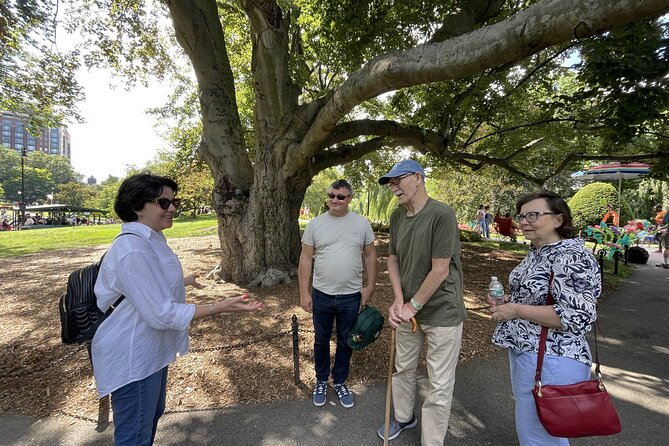
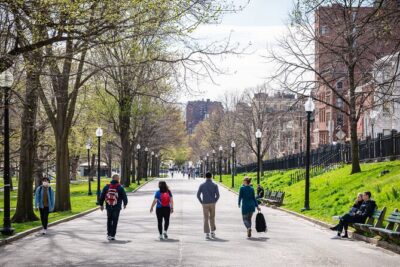
Your tour starts at the Boston Common Visitors Center on Tremont Street. From there, you’re in the right frame of mind fast: Boston Common is America’s oldest public park, dating to 1634. Even if you’ve seen the park in pictures, it lands differently in person—wide open space, monuments nearby, and the sense that the city grew around this green center.
A few key ideas you’ll learn here:
- Telegraph Hill, tied to the historic hill associated with the city’s founding.
- The park’s place in the Emerald Necklace, a green ribbon made up of six parks.
- Major monuments nearby, including the Boston Massacre Memorial, the Great Elm Tree, and the Soldiers and Sailors Monument.
Boston Common is also where the Freedom Trail begins. That matters because you’ll understand the logic of the route early, instead of treating it like a scavenger hunt. Your guide will help you connect what you’re seeing now to what happened centuries ago.
Practical tip: Boston Common is a great early stop because it sets the pace. You’ll have time to look around before you head into narrower, more residential streets.
Beacon Hill’s lavender windows and secret-garden lanes
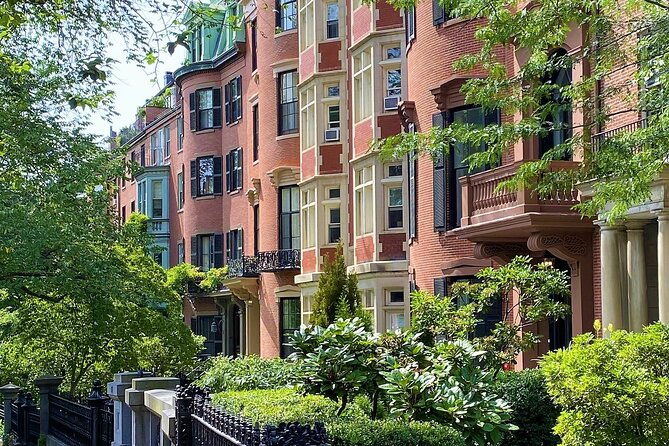
Next comes Beacon Hill, and this is where Boston starts to look like Boston—the kind of streets people dream about. You’ll move along Beacon Street first, where you can admire fine residences associated with prominent New England families.
Then the route focuses on the neighborhood’s “slow down and look up” details:
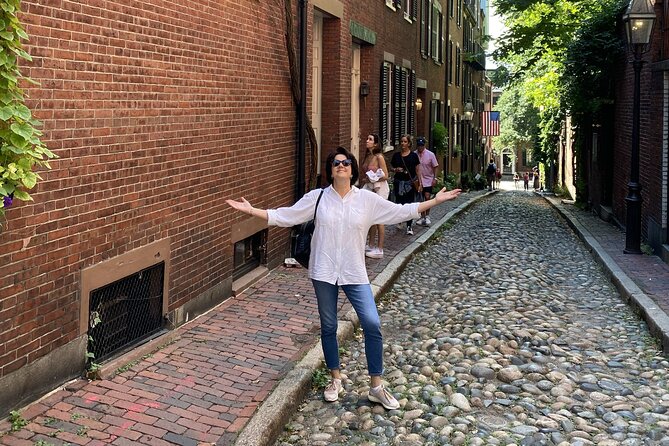
- Houses with lavender windows
- Secret garden style passages
- A charming alley that’s among the most photographed in the area
You’ll also hear about what makes this part of town prestigious—Beacon Hill blends elegance with a very old-school Boston feel, and that contrast is why it photographs so well.
Other standouts on this stretch include:
- The Massachusetts State House, with its golden dome and Federal style design, built in the late 18th century by architect Charles Bulfinch.
- A bronze bas-relief by Augustus Saint-Gaudens.
This Beacon Hill segment is one of the most useful parts of the tour for first-timers because it gives you a visual vocabulary. After this, you’ll recognize the neighborhood vibe in other streets and photos, even on your own afterward.
What to watch for: take a moment at the State House exterior. You’ll feel the scale, and it helps explain why Beacon Hill became a center of civic power.
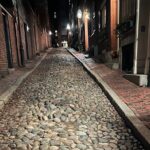
The red brick line keeps going. More Trail walks here
Massachusetts State House to Old City Hall: civic power in stone
After the Beacon Hill photo lanes, you’ll hit the civic architecture cluster that makes this area feel like it runs on tradition. The Massachusetts State House is the big visual anchor. Even if you don’t go inside, the building’s presence dominates the neighborhood and tells you where decisions were made.
From there, you’ll move to Old City Hall, built in 1865 in the French Second Empire style. That’s the style associated with the kind of ornate grandeur you might recognize from Paris landmarks, and it shows up here in Boston in a very specific way. This is the building that hosted Boston’s city council from 1865 to 1969.
Then you’ll connect to the Old Corner Bookstore area. Built in 1718 in the oldest commercial building in downtown Boston, it’s tied to publishing history and helped produce famous American classics. It’s a quick stop, but it adds texture: Boston wasn’t only about revolution and politics. It was also about ideas spreading through books.
For me, this section works because it shows a range of Boston’s identity—government, culture, and commerce—without you needing to choose between them.
Old State House and the Declaration balcony moment

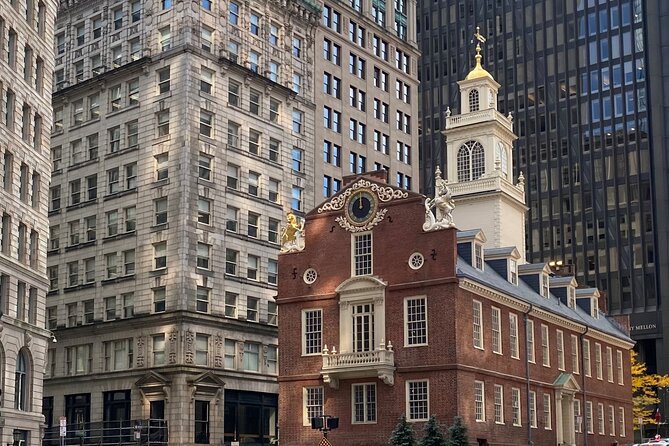
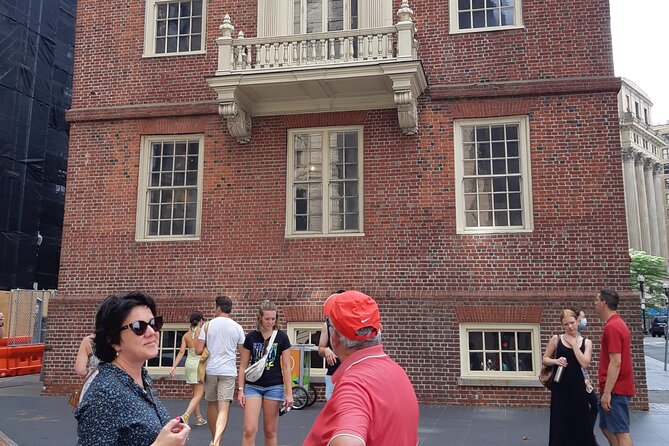
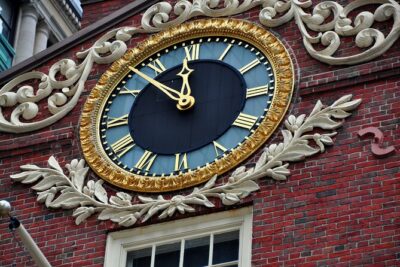
This is one of the most important segments of the walk. You’ll visit the Old State House, built in 1713, and you’ll see how it can look frozen in time when surrounded by newer modern structures.
Here’s the key moment: on July 18, 1776, the text of the United States Declaration of Independence was read from the Old State House balcony. Your guide will put you in position to understand why that balcony mattered—this isn’t an abstract page in a history book. It was spoken here, to people in the streets.
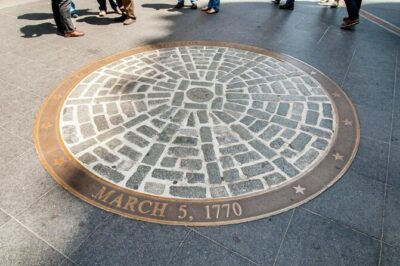
You’ll also see the Boston Massacre site. In 1770, a squadron of the British army opened fire in front of the public building, killing five Bostonians. The event is known as the Boston Massacre, and standing near the area makes it feel real in a way you can’t get from reading alone.
Between these two highlights, you start to sense the emotional push and pull of the Revolution era—public persuasion, tense power, and real consequences.
Photo tip: if you like pictures, don’t just point your camera at the building. Look at street corners and sight lines your guide identifies. That’s where the story usually “clicks.”
Old South Meeting House and the Cradle of Liberty weather vane
As you keep moving through the Freedom Trail core, you’ll stop at the Old South Meeting House. Built in 1729, it was a former Puritan church that served as a gathering place for nearly three centuries. That long timeline is useful for understanding how Boston’s religious and political life braided together.
You’ll also encounter the 1741 Cradle of Liberty, a historic building with a golden weathervane shaped like a grasshopper. That grasshopper became Boston’s first and most famous symbol. It’s one of those small details that makes the tour memorable because it gives you a concrete visual identity for the city.
Stops like this are valuable because they stop the tour from becoming only dates and names. You’ll leave remembering physical details—weathervanes, meeting house shapes, street layouts—that help your brain store the history.
Quincy Market and the food-and-views reset
After more heavy-hitter history, you’ll head to Quincy Market. This former market, built in 1824, is now a food court, with an alley-like feel filled with stalls and shops. It’s a classic spot for a reset because the pace becomes easier. You can grab a snack, recharge, and keep walking without feeling like you’re going from one lecture to another.
You’ll have time here—about 15 minutes. A practical tip: if you want the local-food moment, this is where you can try the lobster roll.
There’s also an “old pedestrian streets” connection behind the Bostonian hotel area, including Blackstone Block, listed on the National List of Historic Places. It’s not a long detour, but it helps you see that Boston’s historic layers extend beyond the obvious Freedom Trail stops.
The goal of this segment is balance. You get a lively square area, a chance to eat, and then you shift toward the North End and the waterfront.
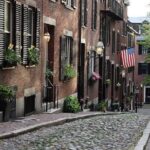
Gas lamps, bow fronts, brownstones. Keep walking
- Downtown Freedom Trail, Beacon Hill & Back Bay Walking Tour★ 4.5 · 473 reviews
- 2-Hour Beacon Hill True Crime Expert Guided Tour★ 5.0 · 182 reviews
- Beacon Hill Boston History + Photo Walking Tour (SMALL Group)★ 5.0 · 163 reviews
- Boston: Underground Railroad History Tour of Beacon Hill★ 5.0 · 141 reviews
- Beacon Hill + Back Bay History + Photo Walking Tour(SMALL Group)★ 5.0 · 60 reviews
North End: Paul Revere House area and the feel of old Boston
Next is the North End, Boston’s northern district and one of the oldest neighborhoods in the city. You’ll spend around 30 minutes here, which is enough time to see the key landmarks and still keep it enjoyable.
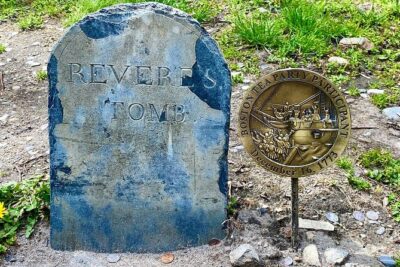
A major highlight is the Paul Revere House. Built in 1676 and among the last vestiges of the colonial era, it’s tied to Paul Revere, who lived there from the 1780s to 1800s. The Revere connection works well because you’ve just been through the Revolution storyline near the State House. Now you’re grounding it in a real home.
You’ll also see the North End church connection: the first church in the North End built on this site in 1650. In the colonial period, it became influential in the Northeast and a stronghold of Puritan faith. You may not “feel” religion as a theme in modern city life, but stopping here helps you understand why certain neighborhoods took the shape they did.
Then you’ll reach the Paul Revere Statue, honoring the Midnight Ride (1775). Even if you’re not a statue person, it helps close the Revere story with a visible endpoint before the tour shifts toward the water.
Boston Harborwalk: the sea-air finish near the aquarium
Once you’ve absorbed the history, the tour finishes with Boston Harborwalk. This is your view reward. You’ll enjoy the promenade along the bay, with views of Boston Harbor and the harbor area. It’s a clean way to end: history on land, then sea air and skyline perspective.
The tour ends at the New England Aquarium on Central Wharf. That’s a convenient finish point if you want to keep exploring on your own right after, especially since it’s easy to connect to other parts of the waterfront area.
If you’re traveling with kids, this ending often lands well because it’s visual and open. If you’re traveling solo or as a couple, it’s also a great moment to take photos without reading another plaque.
Price and logistics: getting value from $350 per group
The price is $350 per group, up to 12 people, for about three hours with a private guide. That’s worth thinking about in a simple way: if you fill the group close to 12, the per-person cost drops a lot. If it’s just two of you, you’re paying a premium for the private experience—but you’re also buying control: pace, questions, and time at the exact spots you care about.
A few value boosters that are explicitly included:
- Local guide services for 3 hours
- An experienced destination specialist guide
- Visit adapted to your wishes and your pace
- The most important sites of Beacon Hill, Freedom Trail, North End, and Harborwalk
- Fees and taxes
What’s not included is transportation, since it’s a walking tour. That’s normal, and it’s also the point: you’re meant to feel the city between stops.
Two practical notes:
- Pickup is offered, which can reduce time wasted getting to the start.
- You’ll have a mobile ticket, and service animals are allowed.
Who should book this private walking tour (and who might want something else)
You should book if:
- It’s your first time in Boston and you want a strong orientation.
- You like history told in plain language, with real-world stops.
- You want a private guide who can slow down for questions and photos.
- You want both the Freedom Trail core and a neighborhood feel in the North End, plus a waterfront finish.
You might want a different format if:
- You want lots of time inside museums or a heavy focus on one single museum.
- You prefer short stops only and don’t want to stand at key historic locations for context.
This tour works especially well for couples, small friend groups, and families who want a guided “big picture” without losing the fun parts of walking city streets.
Should you book it?
I’d book this if you want Boston’s main story in one go: Boston Common into Beacon Hill, then State House era checkpoints, the Massacre and Declaration sites, and finally the North End and Harborwalk. The private structure and guide-focused approach make it feel like a tailored experience rather than a rigid script.
Just make sure you show up ready to walk. Comfortable shoes matter more than almost anything else here, because you’re spending the whole time on streets, sidewalks, and viewpoints rather than sitting in cars.
If your goal is to leave Boston with a mental map and a handful of unforgettable images, this tour delivers that payoff in a very practical way.
FAQ
How long is the tour?
The tour is about 3 hours.
What’s the group size for this private walking tour?
It’s a private tour/activity. Only your group participates, and the group size is up to 12.
What does the $350 price include?
It includes local guide services for 3 hours, the guide, visit fees and taxes, and a tour designed around Beacon Hill, Freedom Trail, North End, and Harborwalk. Museum visits are not planned.
Where does the tour start and end?
It starts at Boston Common Visitors Center, 139 Tremont St, Boston, MA 02111, and ends at New England Aquarium, 1 Central Wharf, Boston, MA 02110.
Is transportation included?
No. This is a walking tour, so transportation is not included.
Is pickup available?
Pickup is offered.
Is the tour ticket mobile?
Yes, it’s listed as a mobile ticket.
Are there admission fees for the stops?
The stops listed are marked as admission ticket free, and the tour includes fees and taxes, with no museum visits planned.
When does the experience run?
The listed hours show 04/01/2025 – 11/01/2025, Monday to Tuesday, 10:00 AM – 5:00 PM.
Can I cancel for a full refund?
Yes. You can cancel up to 24 hours in advance for a full refund.
More of the Boston Ledger




Beacon Hill and Back Bay, Continued

Follow the Red Bricks Further
New on the Boston Docket
- Boston to Newport Mansions Private Day Trip
★ 5.0 · 3 reviews - Boston Massachusetts Private Photography Tour
★ 5.0 · 3 reviews - Homemade Dumplings 101 in Boston
★ 3.5 · 3 reviews - Self-Guided Audio Tour of Boston North End
★ 4.5 · 3 reviews - Old Boston: Beacon Hill & Back Bay Walking Tour in French
★ 4.7 · 3 reviews
Freedom Trail & Revolution Walks, compared.
 ★ 5.0Freedom Trail History Small Group Walking TourFrom $356,450 reviews
 ★ 4.5Boston Freedom Trail Walking Tour with Costumed GuideFrom $262,531 reviews
 ★ 4.5Boston Tea Party Ships and Museum AdmissionFrom $352,512 reviews
 ★ 5.0The Full Revolutionary Story Epic Small Group Boston Walking TourFrom $552,356 reviews
 ★ 4.8Boston Tea Party Ships and Museum Interactive TourFrom $351,926 reviews
 ★ 5.0Boston Food & History: Pizza, North End & Freedom TrailFrom $901,772 reviews
 ★ 4.9Boston’s Freedom Trail: A Revolutionary Walking TourFrom $311,748 reviews
★ 4.9Freedom Trail History Small Group Walking TourFrom $351,590 reviews
★ 4.9Boston’s Freedom Trail: A Revolutionary Walking TourFrom $311,748 reviews
★ 4.9Freedom Trail History Small Group Walking TourFrom $351,590 reviews
Browse the lists this tour appears in