
REVIEW · FREEDOM TRAIL & REVOLUTION WALKS
Private Walking tour of Boston’s Freedom Trail and more!
Freedom Trail landmarks, minus the bus crowds. This private walking tour strings together the big names and the quieter corners of Boston, with a guide who can shape the route to your group. You start downtown, walk a lot, and end in the North End ready for a meal.
I especially like two things. First, the private guide factor: you’re not stuck listening over heads or waiting for slow bodies. Second, so many of the stops are free, which makes the tour feel like real value for a history-heavy morning. In reviews, guides like Tracy, Manny, and Cindy stood out for keeping the stories lively, handling different paces, and answering questions without rushing.
One consideration: you do need moderate physical fitness. Also, the two biggest paid add-ons—Old North Church and the Paul Revere House—are optional, so decide in advance whether you want to spend extra time inside.
In This Review
- Key highlights at a glance
- Starting at 139 Tremont St: a walk you can actually manage
- Boston Common, State House, and Park Street Church: where Boston starts talking
- Granary Burying Ground: read the markers, not just the names
- Benjamin Franklin’s school site and the Old Corner Bookstore: ideas grew here
- Faneuil Hall Marketplace and the liberty-politics loop
- Quick signature stops: Old Boston landmarks without the wandering
- North End finale: Paul Revere House, Old North Church, and Copp’s Hill
- Price, tickets, and how to spend your time wisely
- Who should book this Freedom Trail walking tour (and who might skip it)
- Should you book? My practical take
- FAQ
- How long is the private walking tour of Boston’s Freedom Trail?
- Where does the tour start and where does it end?
- What time does the tour begin?
- Is this tour private or shared with other groups?
- What language is the tour offered in?
- Is admission included for all stops?
- Do I need to bring a printed ticket?
- Is service available for travelers with animals?
- Is the tour suitable for someone with moderate fitness?
- What happens if weather is poor?
Key highlights at a glance
- Private group only means your pace and questions stay yours
- Most stops are free so you control extra ticket time and costs
- A smart downtown start at 139 Tremont St keeps things simple
- A finish in the North End puts lunch within easy reach
- Built-in flexibility lets the guide tailor the route to your interests
- Classic Freedom Trail plus extras so you get more than postcards
Starting at 139 Tremont St: a walk you can actually manage
Boston does not run on slow mornings, and this tour keeps it practical. You meet at 139 Tremont St (10:00am start) and finish in the North End Italian District near 282 Hanover St, where you’ll have plenty of places to grab a snack or lunch.
Because it’s private, you’re not dealing with the usual crush. You also don’t spend half the trip parking, boarding, and re-boarding. It’s a straight-up walking plan designed to get you your bearings fast.
The tour is listed at about 3 hours, and that timing matters. If you try to do the Freedom Trail alone, you can burn time figuring out where to turn. Here, the guide keeps the flow moving, then slows down when your group wants to linger at the interesting bits.
Boston Common, State House, and Park Street Church: where Boston starts talking
You kick off where the story begins: Boston Common. This park dates to 1634 and is America’s oldest public park. The land was tied to Puritan colonists and purchased from early settler William Blackstone, and the Common covers about 44 acres—big enough to feel like the city’s breathing room.
Next, you move toward the Massachusetts State House. It opened in 1798 and was designed by Charles Bulfinch. The building has served as the seat of Massachusetts government ever since, and it sits next to where the historic Hancock mansion once stood. Even without going inside (admission isn’t included), it’s a solid “government roots” waypoint that helps explain why this city’s revolution-era energy became a long-term political machine.
Then comes Park Street Church, founded in 1809 at the corner of Park and Tremont Streets. What I love here is the physical layering: the church sits on top of the site of Boston’s town grain storage building (the granary). The steeple is listed at 217 feet, and the tour notes that it used to be a first landmark for travelers approaching Boston—so you’re basically stepping into the wayfinding system of the 1700s.
The red brick line keeps going. More Trail walks here
Granary Burying Ground: read the markers, not just the names
If Boston Common is the city’s front porch, Granary Burying Ground is the place where the porch stories turn dark. It was established in 1660, and it holds what the tour describes as some of America’s notable citizens and founding figures.
The key detail to watch for is how the burying ground got its name. It’s tied to the granary building nearby, which the tour describes as a 12,000-bushel grain storage structure. That’s a reminder that early Boston was both trade and theology—people stored grain and argued politics, often in the same blocks.
The listing also calls out about 2,300 markers. That number is useful. It tells you this isn’t one neat monument stop; it’s a real cemetery with lots to look at, and your guide helps you spot what matters without you getting lost.
Benjamin Franklin’s school site and the Old Corner Bookstore: ideas grew here
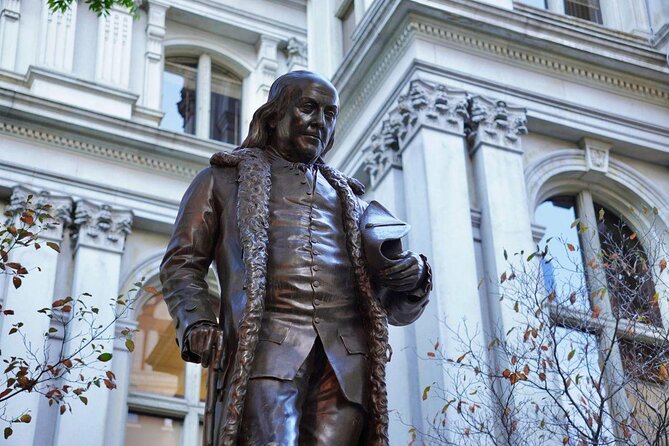
A quick but memorable stop is the Benjamin Franklin marker tied to Boston Latin School. The tour notes the school was founded April 23, 1635 and is the oldest public school in America. I like this stop because it makes freedom trail history feel less like battles only, and more like the systems that formed afterward.
You’ll also hear the school’s early rules: free education for boys, rich or poor, while girls attended private schooling at home. The listing adds another great detail: until a dedicated schoolhouse was completed in 1645, classes ran in the headmaster Philemon Pormont’s home. A mosaic and a statue mark the location of the original schoolhouse.
From there, you hit a building that feels oddly modern in its survival: the Old Corner Bookstore. Built in 1718, it’s described as downtown Boston’s oldest commercial building. The tour connects it to the publisher Ticknor and Fields, known for printing famous American works like Thoreau’s Walden, Hawthorne’s The Scarlet Letter, Longfellow’s Midnight Ride of Paul Revere, and the Atlantic Monthly (including Ward Howe’s Battle Hymn of the Republic).
It’s also saved from demolition in 1960, and the tour notes that leases from the building help subsidize historic preservation in other Boston neighborhoods. That’s one of those small facts that changes how you view the street: you’re not just seeing history; you’re seeing how preservation gets funded.
Faneuil Hall Marketplace and the liberty-politics loop
Then you reach Faneuil Hall Marketplace, one of the tour’s main gravity wells. The tour frames it with two big labels: home of free speech and the Cradle of Liberty. It also notes Faneuil Hall hosted America’s first Town Meeting.
One point I like from the description is that the revolutionary political role wasn’t part of the original plan. The building became politically central because events kept turning toward it. It’s a nice reminder that history often doesn’t follow the blueprint.
Timing here is generous—about 25 minutes—and it’s built for two things: learning and then regrouping. You can step into the adjacent marketplace area afterward for shops and food. Since this tour ends in the North End, having an earlier food option downtown is a comfort too, especially if you’re traveling with kids or anyone who gets hungry fast.
Quick signature stops: Old Boston landmarks without the wandering
After Faneuil Hall, the tour keeps moving through a bundle of key “you’re really on the Freedom Trail” sites. The route name-checks several big hitters, including Quincy Market, Rose Fitzgerald Kennedy Greenway, Haymarket, and Union Oyster House, along with stops like Old South Meeting House, First Public School site, Old City Hall, and Old State House.
Not every one of these is a long-entry stop. Some are short stops where your guide gives you the “why this matters” version. I like this style because it helps you avoid the solo-traveler trap of sprinting past without absorbing anything.
One stop that is specifically called out is the Boston Stone—a round rock embedded in an 18th-century wall. The tour’s angle is the story behind it, which is exactly what you want from a tiny stop. You’ll probably spend only 5 minutes, but if you take a moment to listen, it can turn into a memorable street detail instead of a quick photo.
If you like city texture, there’s also room on this walk to add side interest. In one of the experiences described, the guide stepped off the main path to show places like Pi Alley, the Spite House, and the Holocaust Memorial. That’s the kind of variety that makes walking tours feel less like a checklist and more like a guided day.
Boston was built for walking. More routes
- Boston: Freedom Trail History Small Group Walking Tour★ 5.0 · 6,450 reviews
- Harvard University Campus Guided Walking Tour★ 4.5 · 3,632 reviews
- Boston Freedom Trail Walking Tour with Costumed Guide★ 4.5 · 2,531 reviews
- The Full Revolutionary Story Epic Small Group Boston Walking Tour★ 5.0 · 2,356 reviews
- Boston’s Freedom Trail: A Revolutionary Walking Tour★ 4.9 · 1,748 reviews
North End finale: Paul Revere House, Old North Church, and Copp’s Hill
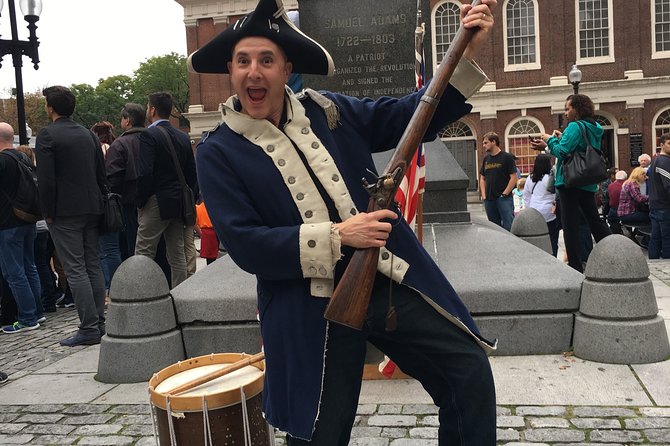
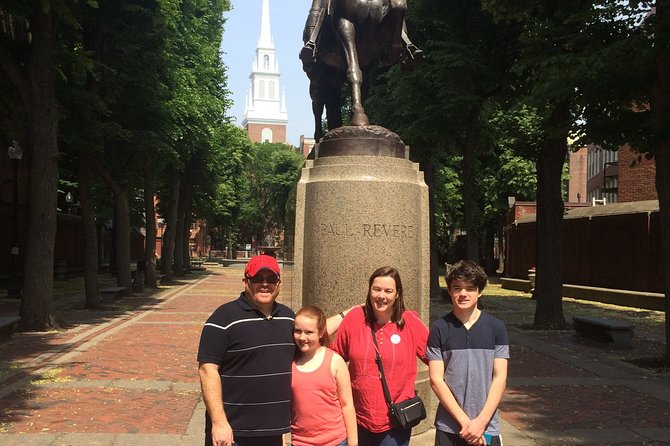
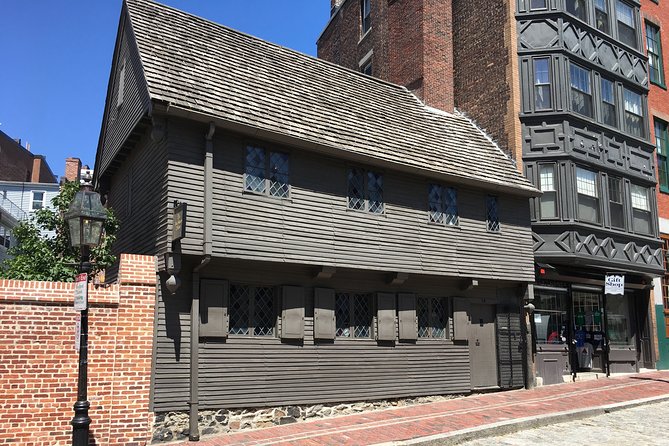
The ending stretch is where the tour gets dramatic. First, you visit the Paul Revere House at 19 North Square. The tour notes it’s downtown Boston’s oldest building and one of the few remaining 17th-century dwellings in a large urban area in the U.S. It also frames the legend around April 18, 1775, when the silversmith left his small wooden home on a mission that became a national story. Admission isn’t included, but the tour indicates you can add it at a special low rate if you want.
Next is Old North Church & Historic Site. This is the signal story: church sexton Robert Newman climbs the steeple and holds up two lanterns on the night of April 18, 1775, to show the British were marching by sea across the Charles River instead of by land. The tour description ties that moment directly to the ignition of the American Revolution.
The church itself is listed as Christ Church in the City of Boston, built in 1723, and described as Boston’s oldest surviving church building and one of the most visited historical sites. Again, admission isn’t included, so you’ll decide how much time you want inside versus outside learning.
Then you end with Copp’s Hill Burying Ground. It’s named after shoemaker William Copp and is described as the final resting place of North End merchants, artisans, and craftspeople. This is a nice tonal shift from lantern drama to real community life. The tour gives you about 20 minutes here, which feels right for a cemetery setting where you’ll want to actually look at what surrounds you.
Price, tickets, and how to spend your time wisely
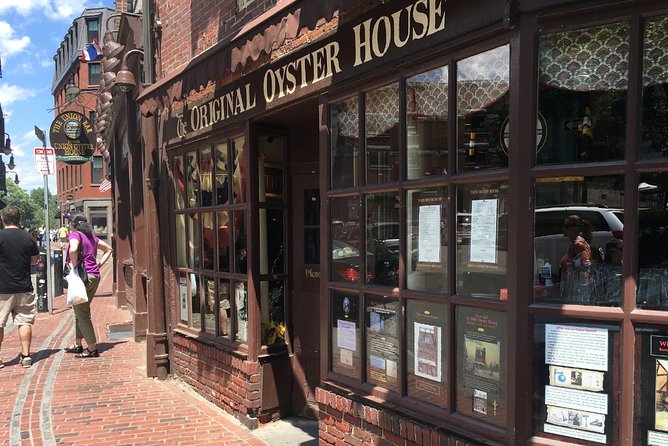
Here’s the value math you can actually use: most of the major stops on this route are free (Boston Common, Granary Burying Ground, Faneuil Hall Marketplace, Copp’s Hill, and many quick photo stops). The two places that typically cost extra are the Old North Church and the Paul Revere House.
So you can budget in a controlled way. If you’re short on time, stick to the free exterior viewing and let your guide fill in the story. If you want the full interiors at the end—especially for the Revolution sites—add those optional admissions. The tour notes they offer a very special low rate, which is usually the difference between skipping and actually going in.
Also pay attention to how the guide handles pacing. In reviews, guides like Cindy and Ellen adjusted to slower walkers and kept everyone engaged, including teens. If your group includes mixed ages or different walking speed, the private format helps a lot.
Who should book this Freedom Trail walking tour (and who might skip it)
This is ideal if you want a first-time Boston history framework without the big-tour circus. You’ll get classic anchors—Boston Common, Faneuil Hall, Old North Church—and also the street-level stories that make those anchors make sense.
It also suits families with kids who can handle a story-driven morning, as long as everyone can do about 3 hours of walking with a moderate fitness level. If your group includes someone who gets bored fast, the private guide format matters, because they can adjust questions and pacing.
You might want to skip this format if you hate walking or you want a purely museum-style day with lots of long indoor stops. This one is built for moving, stopping, listening, and then moving again.
Should you book? My practical take
If you want the Freedom Trail experience but with room to think, ask, and move at your own pace, I’d book it. The best part is the mix: big-name landmarks plus smaller stops like the Old Corner Bookstore and Boston Stone that make the day feel lived-in, not just historic.
Two quick decisions will help you get the most out of it. First, decide whether you’ll add Old North Church and the Paul Revere House admissions. Second, plan for North End lunch right after—because ending near 282 Hanover St is exactly where you’ll want to eat.
If you’re the type who likes your history delivered like a story and paced like a conversation, this private walking tour is a strong match.
FAQ
How long is the private walking tour of Boston’s Freedom Trail?
The tour is about 3 hours.
Where does the tour start and where does it end?
It starts at 139 Tremont St, Boston, MA 02111, USA. It ends at a North End Italian District restaurant near 282 Hanover St, Boston, MA 02113, USA.
What time does the tour begin?
The start time is listed as 10:00am.
Is this tour private or shared with other groups?
It’s private. Only your group participates.
What language is the tour offered in?
The tour is offered in English.
Is admission included for all stops?
No. Admission is not included for the Old North Church and the Paul Revere House. Other stops listed are marked free where applicable.
Do I need to bring a printed ticket?
You’ll have a mobile ticket.
Is service available for travelers with animals?
Service animals are allowed.
Is the tour suitable for someone with moderate fitness?
The tour notes that travelers should have a moderate physical fitness level.
What happens if weather is poor?
The experience requires good weather. If it’s canceled due to poor weather, you’ll be offered a different date or a full refund.
On Foot Through Old Boston


More of the Boston Ledger



Follow the Red Bricks Further
New on the Boston Docket
- Boston to Newport Mansions Private Day Trip
★ 5.0 · 3 reviews - Boston Massachusetts Private Photography Tour
★ 5.0 · 3 reviews - Homemade Dumplings 101 in Boston
★ 3.5 · 3 reviews - Self-Guided Audio Tour of Boston North End
★ 4.5 · 3 reviews - Old Boston: Beacon Hill & Back Bay Walking Tour in French
★ 4.7 · 3 reviews
Freedom Trail & Revolution Walks, compared.
 ★ 5.0Freedom Trail History Small Group Walking TourFrom $356,450 reviews
 ★ 4.5Boston Freedom Trail Walking Tour with Costumed GuideFrom $262,531 reviews
 ★ 4.5Boston Tea Party Ships and Museum AdmissionFrom $352,512 reviews
 ★ 5.0The Full Revolutionary Story Epic Small Group Boston Walking TourFrom $552,356 reviews
 ★ 4.8Boston Tea Party Ships and Museum Interactive TourFrom $351,926 reviews
 ★ 5.0Boston Food & History: Pizza, North End & Freedom TrailFrom $901,772 reviews
 ★ 4.9Boston’s Freedom Trail: A Revolutionary Walking TourFrom $311,748 reviews
★ 4.9Freedom Trail History Small Group Walking TourFrom $351,590 reviews
★ 4.9Boston’s Freedom Trail: A Revolutionary Walking TourFrom $311,748 reviews
★ 4.9Freedom Trail History Small Group Walking TourFrom $351,590 reviews
Browse the lists this tour appears in