
REVIEW · FREEDOM TRAIL & REVOLUTION WALKS
Freedom Trail: Boston Common, Old State House, Faneuil Hall
Boston’s fight for liberty walks right in front of you. On this 2-hour Freedom Trail highlights walk, I love how the guide makes the Revolution feel personal, not textbook. You start near Park St. and end at Faneuil Hall, with famous moments like the Boston Massacre and the Declaration of Independence brought to life by a licensed guide named Brian.
Two things I especially like: first, Brian’s storytelling is fast, funny, and packed with specific details (including that real Boston accent that adds flavor). Second, you get a lot of headline sites in a short window, so it works even if Boston is just a stop on a busy trip. One possible drawback: the pace is “highlights” pace—great for a first pass, but it won’t replace a longer look at any one building or museum.
In This Review
- Key Highlights That Make This Tour Worth Your Time
- A 2-Hour Freedom Trail Sprint That Still Feels Meaningful
- Getting Started: Boston Common and the Park St. Church Area
- Seeing the Massachusetts State House Without Needing a Museum Ticket
- Park Street Church: Anti-Slavery Sermons and a Skyline Landmark
- Granary Burying Ground: Where Names Turn Into Stories
- King’s Chapel: Georgian Architecture Plus Loyalist Complications
- Old South Meeting House: Boston Tea Party Planning, in Plain View of the Past
- Old Corner Bookstore: A Publishing Hub You Probably Never Expected
- Old State House and the Declaration Balcony Moment
- Boston Massacre Site: A Marker That Feels Heavier With Context
- Ending at Faneuil Hall: Cradle of Liberty Energy
- Price, Time, and Who This Tour Fits Best
- Tips to Get the Most From a Walking Highlights Tour
- Should You Book This Freedom Trail Highlights Tour?
- FAQ
- Where does the tour start and end?
- How long is the Freedom Trail highlights tour?
- How much does the tour cost?
- What language is the live guide tour in?
- Is the tour wheelchair accessible?
- What’s included in the price?
Key Highlights That Make This Tour Worth Your Time
- Boston Common (founded 1634) gives you an easy, calming start before the drama of the Revolution.
- Granary Burying Ground connects you to Paul Revere, Samuel Adams, John Hancock, and Crispus Attucks.
- Old South Meeting House is where plans for the Boston Tea Party were set in motion.
- Old State House puts the Declaration’s balcony scene and colonial government under one roofline.
- Boston Massacre site (1770) turns a marker into a moment, not just a stopping point.
- Faneuil Hall, the Cradle of Liberty, ends the walk with the feeling of debate and action.
A 2-Hour Freedom Trail Sprint That Still Feels Meaningful
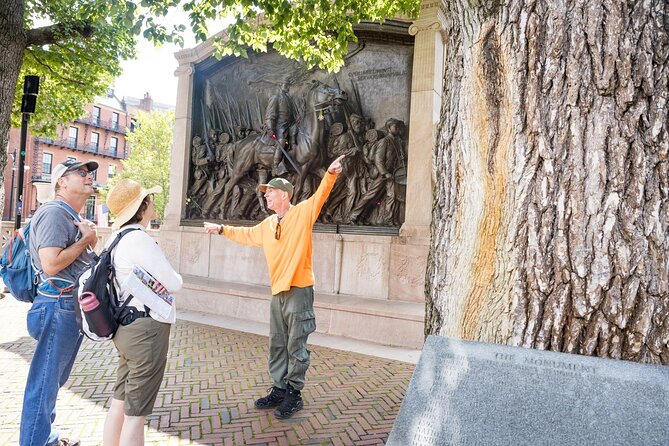
Boston’s historic center is compact, but it’s also loaded. This guided highlights format is built for people who want the big moments without burning a whole day. You’ll be walking through central neighborhoods tied to rebellion, war, and independence—while hearing why each place mattered in real time.
At $39 per person for about 2 hours, the value comes from the combo: licensed guide + concentrated stops + context. If you’ve only got one shot to “do the Freedom Trail,” this is the kind of plan that helps you get oriented quickly, then decide what to revisit later on your own.
Getting Started: Boston Common and the Park St. Church Area
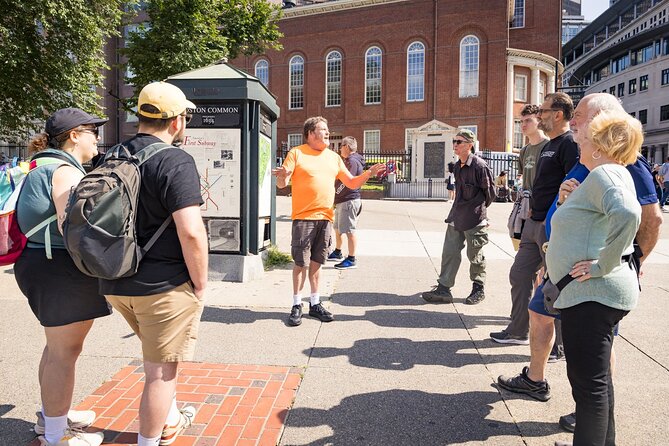
Your tour begins outside the Park St. T Station on the eastern edge of Boston Common. That’s smart—Boston Common is easy to find, easy to meet at, and it gives you an instant sense of place before you tackle the more charged sites.
Boston Common, founded in 1634, is America’s oldest public park. I like using it as a mental reset. You’re standing on ground tied to British troop encampments during the Revolutionary era, but you can still feel how a park can serve many eras at once, including later public gatherings in the 20th century.
Expect the walk to move from calm to serious pretty quickly. Boston Common isn’t just greenery here—it’s the “before” story, the baseline where you understand what the colonists were fighting for later.
The red brick line keeps going. More Trail walks here
Seeing the Massachusetts State House Without Needing a Museum Ticket
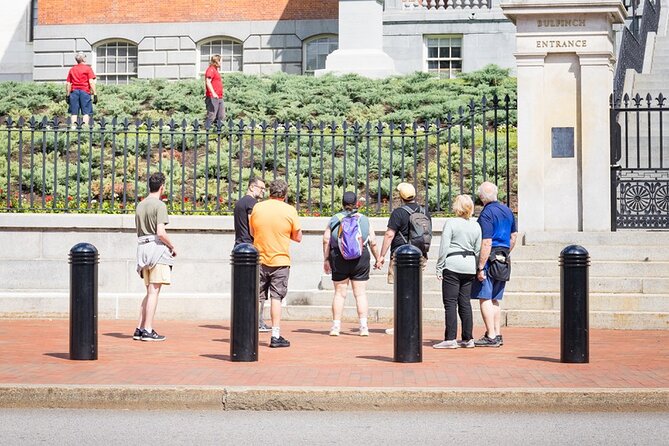
One of the stops on this Freedom Trail highlights route is the Massachusetts State House, completed in 1798. You’ll get a clear look at the famous golden dome, and you’ll also learn what it does beyond looking impressive from the outside.
This matters because it’s part of the Revolution’s afterlife. The same spirit that sparked rebellion didn’t end with independence—it turned into the reality of government and legislation. So even if you’re not planning to go inside, it’s still a useful stop to connect “fight” to “system.”
Practical tip: the State House area can be busy, and photos compete with foot traffic. If you care about getting a clean shot, plan on moving quickly and stepping aside when you can.
Park Street Church: Anti-Slavery Sermons and a Skyline Landmark
Park Street Church was erected in 1809, and it’s a major Boston landmark with a tall steeple that’s visible in a lot of views. What makes it more than a pretty stop is the way the tour frames its role in earlier progress movements—specifically the first public anti-slavery address in the U.S.
This is the kind of place that can feel like “another church” if you’re doing the route on your own. With a guide, it becomes a point on the timeline showing that the fight for liberty wasn’t only about independence from Britain.
If you’re traveling with kids, this is one of the stops that can land well because it tells a clear story: big speech, big consequences, real people involved.
Granary Burying Ground: Where Names Turn Into Stories
If you want your Freedom Trail experience to feel real, Granary Burying Ground is where that happens. It’s one of Boston’s oldest cemeteries, and it serves as a final resting place for many figures tied to the American Revolution—like Paul Revere, Samuel Adams, and John Hancock.
The standout moment here is Crispus Attucks, identified as the first casualty of the Boston Massacre. When you hear that connection explained on-site, the cemetery stops being a quiet backdrop and becomes part of the meaning of 1770.
A good strategy: slow down when you reach this stop. Don’t rush past names just to check boxes. If Brian gives you a key detail, take a second. Cemeteries reward attention.
King’s Chapel: Georgian Architecture Plus Loyalist Complications
King’s Chapel, built in 1754, is described as Georgian architecture and one of Boston’s oldest churches. The tour’s angle here is interesting: it includes the fact that the chapel had ties to loyalist congregants during the Revolution.
That loyalist connection is a useful counterweight. Independence stories can get simplified into one side being all heroes and the other side being all villains. A place like King’s Chapel helps you understand that Revolution-era Boston was divided in real, religious, and community ways.
If you like complexity, you’ll appreciate this stop. If you want a purely action-focused narrative, you might find it slower—but it adds perspective.
Rainy day in Boston? These doors are open
- Boston: View Boston Observation Deck Entry Ticket★ 4.7 · 1,451 reviews
- New England Aquarium Admission Ticket in Boston★ 4.0 · 446 reviews
- Boston: Franklin Park Zoo Entry Ticket★ 4.3 · 430 reviews
- Boston Pass: 40+ Things To Do – Includes Franklin Park Zoo★ 4.0 · 359 reviews
- View Boston Observation Deck Admission Tickets★ 4.5 · 314 reviews
Old South Meeting House: Boston Tea Party Planning, in Plain View of the Past
The route includes Old South Meeting House, built in 1729. This is where plans for the Boston Tea Party were famously set into motion—so you’re standing at the birthplace of one of the most well-known acts of colonial protest.
This stop is great for two reasons. First, it explains how protest escalated from politics into direct action. Second, it helps you connect the tea tax story to people gathering, debating, and organizing.
If you’re the kind of person who thinks, I get the big idea, but how did it actually happen?—this is one of those moments where a guided walk really helps. The meeting house stops being a symbol and becomes a location with a job to do.
Old Corner Bookstore: A Publishing Hub You Probably Never Expected
Next, you may pass the Old Corner Bookstore, once a hub for the literary elite in the 19th century. The tour frames it as a publishing center for iconic authors like Louisa May Alcott.
This stop is easy to overlook if you expect every second to be battles and pamphlets. But I like including it because it shows another route to influence: ideas spread through print. The Revolution era was full of speeches and gatherings, but text mattered too.
If you care about how societies change, you’ll find this kind of stop satisfying.
Old State House and the Declaration Balcony Moment
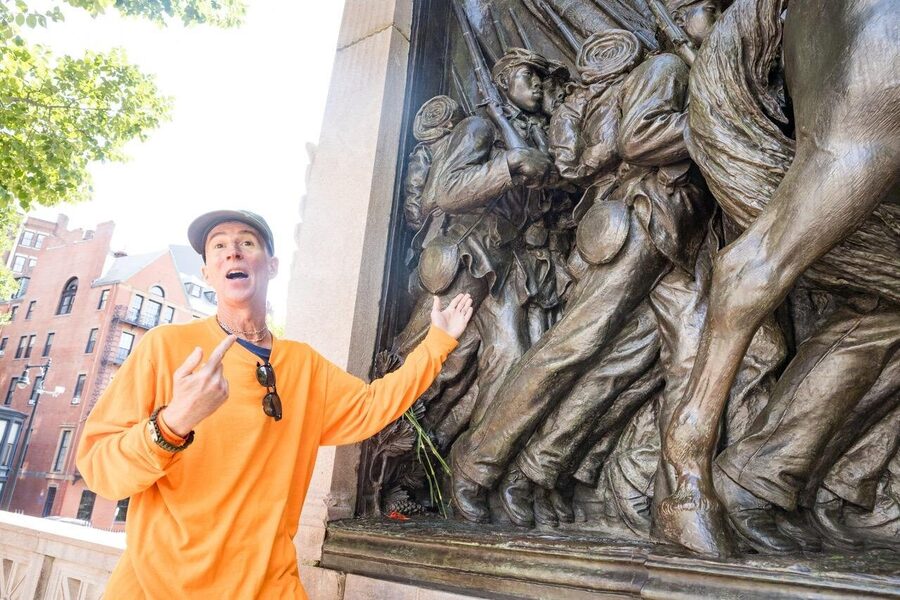
Old State House dates to 1713 and served as the seat of colonial government. It’s also part of the story for the Declaration of Independence being read from its balcony, which is tied to igniting a quest for liberty.
This is one of the most important stops on the Freedom Trail highlights approach. Not because it’s the flashiest, but because it gives you the “why” behind independence. You’re not just hearing about events—you’re seeing the government setting where decisions were made and where the public message landed.
Practical note: this is a busy public area. If you want photos, be quick and be respectful. The best experience comes from listening first, then snapping a shot after the key points land.
Boston Massacre Site: A Marker That Feels Heavier With Context
The route includes the Boston Massacre site, marking where tensions between colonists and British soldiers escalated into the infamous Boston Massacre of 1770. The tour frames it as a stark reminder of the sacrifices made in pursuit of independence.
What makes this stop work on a guided highlights walk is the connection. It’s not just a date—it ties back to names like Crispus Attucks and helps you understand how violence became propaganda and motivation.
You may find yourself pausing here longer than you planned. That’s a good sign. This is one of those “human scale” moments where history stops being abstract.
Ending at Faneuil Hall: Cradle of Liberty Energy
Your tour ends at Faneuil Hall, known as the Cradle of Liberty. It has served as a marketplace and meeting hall since 1742, and it hosted fiery debates and speeches advocating for independence.
This ending is strong because it returns you to the theme of public argument—people gathering, speaking, persuading, and pushing the next step. After cemeteries and conflict markers, Faneuil Hall gives you momentum.
If you’re hungry (and you haven’t planned food), this is a natural spot to keep moving. The tour doesn’t include meals, so I recommend having a snack in your day bag before you start, or planning a post-tour meal nearby.
Price, Time, and Who This Tour Fits Best
At $39 for about 2 hours, this tour makes most sense if:
- you want the Freedom Trail’s main hits without committing to the full longer route
- you’re short on time and want your bearings fast
- you like storytelling that connects locations to decisions, speeches, and consequences
- you’re traveling with kids and want an explanation that keeps them engaged (the reviews highlight that the pace and storytelling work well)
If you’re the type who plans to spend serious time inside every building, you might find this tour a helpful primer rather than a complete experience. Think of it as a guided map of meaning—then you choose what to revisit on your own.
Tips to Get the Most From a Walking Highlights Tour
- Wear comfortable walking shoes. The route is history-heavy, so you’ll spend more time on your feet than you might expect.
- Bring a phone camera, but don’t let photos break your listening rhythm. Brian’s stories are the point.
- If weather is questionable, dress for it. The guide’s energy is meant to keep the group moving, rain or shine.
- If you want to follow up afterward, take note of the places that sparked your interest most. That’s where you’ll get the best “second visit.”
Should You Book This Freedom Trail Highlights Tour?
Yes—if you want the Freedom Trail’s big stories in a tight time window and you value a guide who can turn locations into scenes. This is especially worth booking if you’re doing Boston as a short trip and want to cover Boston Common, the Old State House Declaration moment, and Faneuil Hall in one clean plan.
Skip it or pair it with more time if your goal is slow, museum-style touring with lots of deep reads at every stop. In that case, this is still a great start—but you’ll want extra hours afterward to go beyond the highlights.
FAQ
Where does the tour start and end?
It starts outside the Park St. T Station on the eastern edge of Boston Common, and it ends at Faneuil Hall.
How long is the Freedom Trail highlights tour?
The tour lasts about 2 hours.
How much does the tour cost?
The price is listed as $39 per person.
What language is the live guide tour in?
The live tour guide provides the experience in English.
Is the tour wheelchair accessible?
Yes, the tour is wheelchair accessible.
What’s included in the price?
The tour includes a guided highlights tour with an expert licensed guide. Food and drinks, and hotel pickup/drop-off are not included.
More of the Boston Ledger




Boston Behind the Turnstiles



Follow the Red Bricks Further
New on the Boston Docket
- Boston to Newport Mansions Private Day Trip
★ 5.0 · 3 reviews - Boston Massachusetts Private Photography Tour
★ 5.0 · 3 reviews - Homemade Dumplings 101 in Boston
★ 3.5 · 3 reviews - Self-Guided Audio Tour of Boston North End
★ 4.5 · 3 reviews - Old Boston: Beacon Hill & Back Bay Walking Tour in French
★ 4.7 · 3 reviews
Freedom Trail & Revolution Walks, compared.
 ★ 5.0Freedom Trail History Small Group Walking TourFrom $356,450 reviews
 ★ 4.5Boston Freedom Trail Walking Tour with Costumed GuideFrom $262,531 reviews
 ★ 4.5Boston Tea Party Ships and Museum AdmissionFrom $352,512 reviews
 ★ 5.0The Full Revolutionary Story Epic Small Group Boston Walking TourFrom $552,356 reviews
 ★ 4.8Boston Tea Party Ships and Museum Interactive TourFrom $351,926 reviews
 ★ 5.0Boston Food & History: Pizza, North End & Freedom TrailFrom $901,772 reviews
 ★ 4.9Boston’s Freedom Trail: A Revolutionary Walking TourFrom $311,748 reviews
★ 4.9Freedom Trail History Small Group Walking TourFrom $351,590 reviews
★ 4.9Boston’s Freedom Trail: A Revolutionary Walking TourFrom $311,748 reviews
★ 4.9Freedom Trail History Small Group Walking TourFrom $351,590 reviews
Browse the lists this tour appears in