
REVIEW · FREEDOM TRAIL & REVOLUTION WALKS
Downtown Freedom Trail Walking Tour – History & Architecture
Freedom Trail stories land differently when you walk them in downtown Boston. This guided Freedom Trail walk (about 70 minutes) connects major American Revolution stops like the Old State House and Boston Massacre site with the architecture around them. I also like that the tour is run in a small group setting, and guides such as Alan or Andrew can keep things friendly, funny, and easy to follow.
My main caution: this is an outdoor street walk. It runs in all weather and can involve rain, so you’ll want solid shoes and a plan for wet streets (or sun).
In This Review
- Key highlights worth planning for
- Why the Downtown Freedom Trail Works So Well in One Stretch
- Getting Started at State Street and Congress Street (and Why It Matters)
- The Core Route: Faneuil Hall to Boston Common, With Stops That Tell the Story
- Faneuil Hall and Quincy Market: The Protest Marketplace Moment
- The Boston Massacre Site and Park Street Church: When History Shows Its Footprint
- Old State House and the Balcony Detail That Changes Everything
- King’s Chapel and Tremont Temple: Churches as Political and Social Infrastructure
- Old South Meeting House, Old Corner Bookstore, and the Author Hangout
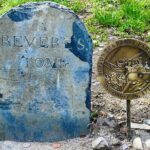
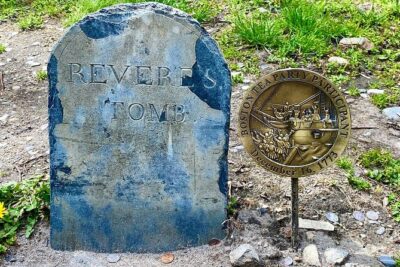
- Old Granary Cemetery: Paul Revere, Samuel Adams, and John Hancock
- Boston Common and the New State House Gold Dome
- Price and Value: What $45 Buys in 70 Minutes
- Guide Style Can Make or Break the Experience
- Who This Tour Is For (and Who Might Pair It With Something Else)
- Should You Book This Downtown Freedom Trail Tour?
- FAQ
- How long is the Downtown Freedom Trail Walking Tour?
- How much does the tour cost?
- Where do I meet the guide, and where does the tour end?
- What time does the tour start?
- Is the tour offered in English?
- Do I need a printed ticket?
- How many people are in the group?
- Are children allowed?
- What about weather and refunds?
- What is the cancellation policy?
Key highlights worth planning for
- 70-minute route from Faneuil Hall area down to Boston Common
- Major stops like the Old State House, Park Street Church, King’s Chapel, and Old Granary Cemetery
- Architecture + history together, not one or the other
- Small groups (max 20) that make questions feel possible
- Guides with humor and flexibility, with examples of help during rain
- Optional add-on beyond Boston Common sometimes offered for an extra $15
Why the Downtown Freedom Trail Works So Well in One Stretch
Boston’s Freedom Trail is easy to spot on a map, but it’s harder to understand without context. This tour helps you connect the dots fast: who lived where, why power shifted, and how the buildings around you shaped public life. You get the big landmarks, but also the “in-between” spots that make the downtown layout feel like one connected story.
What makes this format especially useful is the pacing. With a 1 hour 10 minute timeline, you’re not stuck for half a day. You also get enough stops to build momentum—rather than wandering one site at a time, half-remembered from school.
Getting Started at State Street and Congress Street (and Why It Matters)
The meeting point is State Street at Congress Street in Boston (near public transportation). The start time is 10:00 am, and you’ll end at Brewer Fountain on the Freedom Trail.
A practical tip: arrive a few minutes early. Downtown can be busy, and you don’t want to waste your tour time hunting for your group. The tour uses a mobile ticket, which is one less thing to manage while you’re figuring out transit and street crossings.
Group size stays capped at 20, which changes the feel. You’re walking with enough people to have energy, but not so many that you disappear into the crowd.
The red brick line keeps going. More Trail walks here
The Core Route: Faneuil Hall to Boston Common, With Stops That Tell the Story
The tour’s arc is from the Old State House area toward the new State House, with the classic Freedom Trail sequence between Faneuil Hall and Boston Common. Think of it as a guided walk through key turning points—protests, crackdowns, sermons, meeting houses, and civic buildings—so the city’s history stops feeling like separate chapters.
Along the way, you’ll pause at locations tied to major events and iconic institutions. Some stops are about government and conflict. Others are about religion and community. That mix matters, because Boston wasn’t only “politics.” It was also churches, schools, and public spaces where ideas traveled.
Faneuil Hall and Quincy Market: The Protest Marketplace Moment
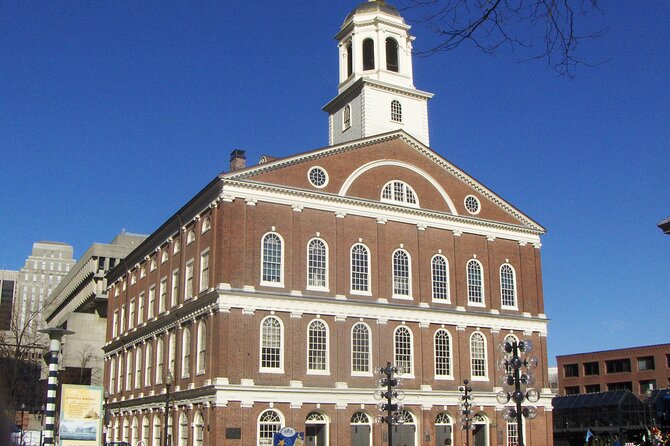
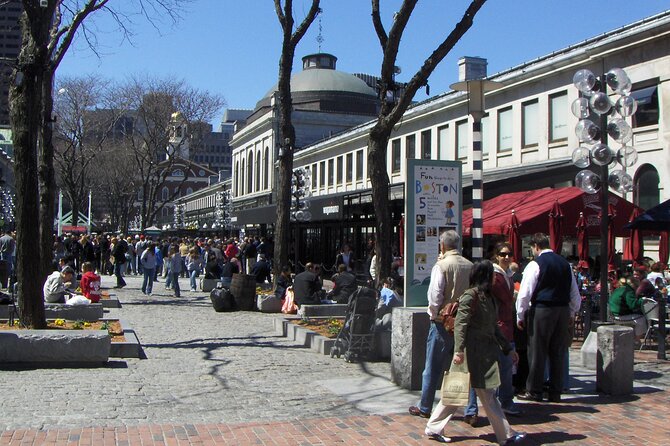
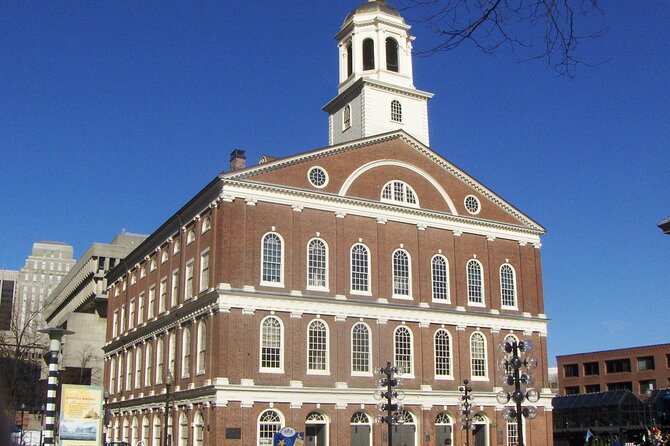
One of the first big emotional beats is Faneuil Hall (the tour also brings you into the Quincy Market area nearby). This is the marketplace that helped earn Boston the nickname Cradle of Liberty—protests that fueled revolutionary energy happened right there.
What I like about starting here is the tone. You begin with a place designed for crowds and debate. It makes it easier to understand why later sites on the trail feel tense: once you’ve seen how public action worked in the open, you’re ready for the push-and-pull of colonial conflict.
A small visual tip the tour points out: look up at the famous grasshopper weathervane at Faneuil Hall.
The Boston Massacre Site and Park Street Church: When History Shows Its Footprint
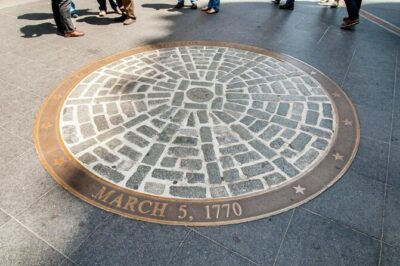
Next comes the Boston Massacre site, marked by a cobblestone ring in the pavement. That kind of street-level marker is powerful. It stops history from staying theoretical. You’re literally standing at the exact moment where a skirmish helped ignite rebellion.
From there, the walk includes Park Street Church. This is the kind of stop that helps you see how religion and public life overlapped in colonial Boston. Even if you’re not a church person, it adds context for how people organized beliefs, community, and response to government pressure.
Old State House and the Balcony Detail That Changes Everything
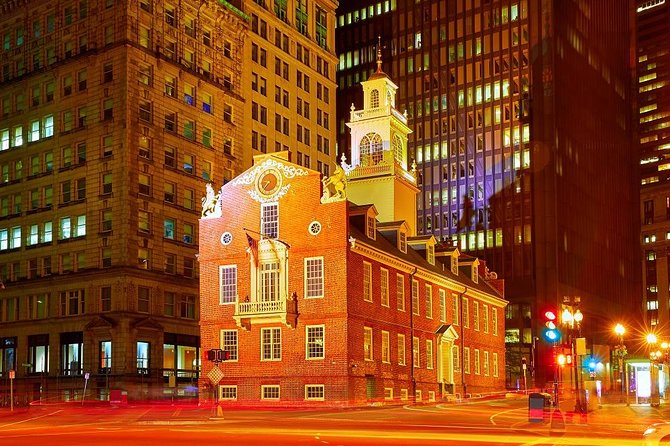
The tour highlights the Old State House area, including the detail that the Declaration of Independence was first read to Bostonians from its balcony. That one fact makes the building feel less like brick-and-stone and more like a stage.
If you’re the type who likes architecture, you’ll appreciate how the buildings along the trail act like time machines. If you’re more history-focused, that balcony detail gives you a clear cause-and-effect moment to anchor your memory.
Boston was built for walking. More routes
- Boston: Freedom Trail History Small Group Walking Tour★ 5.0 · 6,450 reviews
- Harvard University Campus Guided Walking Tour★ 4.5 · 3,632 reviews
- Boston Freedom Trail Walking Tour with Costumed Guide★ 4.5 · 2,531 reviews
- The Full Revolutionary Story Epic Small Group Boston Walking Tour★ 5.0 · 2,356 reviews
- Boston’s Freedom Trail: A Revolutionary Walking Tour★ 4.9 · 1,748 reviews
King’s Chapel and Tremont Temple: Churches as Political and Social Infrastructure
King’s Chapel gets its own attention, and for good reason. The tour notes its long timeline starting in 1686 and spanning major shifts through the Revolution and beyond. It’s one of those sites where the building’s age helps you understand how long ideas took to change.
Then you’ll move toward Tremont Temple. The story here is especially interesting: it’s described as the first integrated church in America, and the tour also connects its public event role to speeches against slavery by people such as Sam Houston and Frederick Douglass.
That’s a theme to keep in mind for this tour: the guide isn’t only showing landmark buildings. You’re also hearing how community spaces shaped social change.
Old South Meeting House, Old Corner Bookstore, and the Author Hangout
The walk includes the Old South Meeting House, plus the Old Corner Bookstore. The meeting house matters because it ties you to the revolutionary era rhythm of gatherings and planning. The tour’s framing helps you see why public meetings weren’t casual events; they were part of how resistance organized.
The Old Corner Bookstore is a different kind of stop. The tour explains it was built in 1718 as a residence and apothecary shop, later becoming a bookstore in 1828. It also mentions that major writers such as Ralph Waldo Emerson and Charles Dickens once gathered there.
I like this stop because it widens the definition of “history.” It’s not only what happened in political squares. It’s also how ideas moved through readers, writers, and conversation.
Old Granary Cemetery: Paul Revere, Samuel Adams, and John Hancock
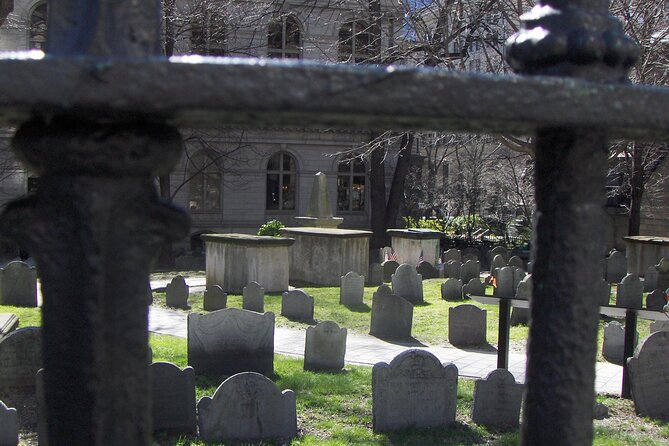
If you’ve walked through enough “historic” districts, you’ll know cemeteries can feel solemn or ignored. This stop is handled with clarity: you reach the final resting place of Paul Revere, Samuel Adams, and John Hancock, and the tour points out how visited this cemetery is.
Even if you’re not into grave markers, this is a useful moment to slow down. It gives you a human scale for the Revolution era. You’re not only hearing what happened; you’re learning who lived through it—and then seeing their names remain part of the city’s daily identity.
Boston Common and the New State House Gold Dome
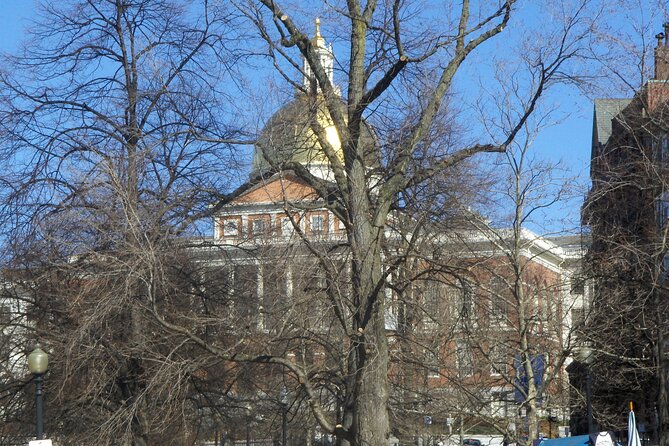
The tour ends at Boston Common, and you also get the new State House (built 1798) with its iconic 23-karat gold dome. Boston Common is the oldest city park in the United States, and it’s a big open space—50 acres bounded by major streets.
Ending here is smart. It gives you a breather after a dense downtown walk and helps you connect civic power (the State House) with public space (the Common). If your group is lucky, you’ll also get a real feel for how Boston uses these spaces today.
One real-world note: sometimes Boston Common has events or demonstrations. That’s out of the guide’s control, but it can affect how the last moments feel.
Price and Value: What $45 Buys in 70 Minutes
$45 per person for about 70 minutes is a solid deal when you consider what you’re actually getting: a guided explanation of multiple Freedom Trail sites with context for how architecture and public life connect. You’re not just reading plaques on your own.
Also, the tour description indicates admission is free for the main Freedom Trail portion. While you still should expect normal outdoor walking and pausing time, you’re less likely to hit surprise ticket barriers mid-route.
One more value angle: because the group is small (max 20), you can ask questions without feeling swallowed by the pack. That tends to make the time feel more “earned,” not just watched.
And if you’re planning ahead, note that the tour is often booked around 55 days in advance. If your schedule is fixed, booking early helps you lock in the 10:00 am start.
Guide Style Can Make or Break the Experience
This tour’s best moments are often about the guide. The reviews highlight guides who are friendly, welcoming, and funny, with an ability to keep momentum even when weather turns ugly. There are also examples of guides adjusting when people get lost on the way to the meeting spot, and accommodating families so everyone stays engaged.
There’s also one practical caution from feedback: sound can be an issue if you’re not close enough. If you care about hearing every detail, try to position yourself where the guide’s voice carries.
Finally, expect the guide to connect history to architecture and everyday life. If you wanted only tightly focused Revolution-era facts, you may find the tour stretches into broader social themes that connect to Boston institutions (including references that came up in one review, such as Malcolm X). That range can be a plus, but it’s good to know what you’re signing up for.
Who This Tour Is For (and Who Might Pair It With Something Else)
This is ideal for:
- First-time Boston visitors who want a high-impact overview without guessing what matters
- History lovers who want names, dates, and clear turning points tied to places
- Families looking for a structured walk that doesn’t drag
You might pair it with something else if:
- you want deep, single-subject detail (like only revolution battles, or only architecture)
- you’re very sensitive to crowd noise or outdoor conditions and want a shorter, more sheltered plan
Should You Book This Downtown Freedom Trail Tour?
I think it’s a strong choice if you want to understand the Freedom Trail quickly. For $45, you get a compact walk with major stops—from Faneuil Hall and the Old State House to King’s Chapel, Tremont Temple, and Boston Common—plus a guide who turns the street layout into a story you can remember.
Book it when:
- you’re short on time but want to hit the key sites
- you like learning history through buildings and public spaces
- you want a small-group experience that stays social, not stiff
Skip or rethink it if:
- you need a fully seated, indoor experience
- you’re expecting long, ultra-deep storytelling on only one narrow theme
- weather sensitivity is your biggest concern (because you’ll be outside, in all conditions)
If you’re happy walking and you want context, this is one of the better ways to get your bearings in Boston fast—and still feel like you saw the real city, not just a checklist.
FAQ
How long is the Downtown Freedom Trail Walking Tour?
It runs about 1 hour 10 minutes (around 70 minutes).
How much does the tour cost?
The price is $45.00 per person.
Where do I meet the guide, and where does the tour end?
You meet at State Street at Congress Street, Boston, MA 02203, and end at Brewer Fountain on the Freedom Trail.
What time does the tour start?
The start time listed is 10:00 am.
Is the tour offered in English?
Yes, the tour is offered in English.
Do I need a printed ticket?
No. The tour includes a mobile ticket.
How many people are in the group?
The tour has a maximum of 20 travelers.
Are children allowed?
Children must be accompanied by an adult.
What about weather and refunds?
The tour operates in all weather conditions, so dress appropriately. It also notes that it requires good weather, and if it’s canceled due to poor weather, you’ll be offered a different date or a full refund.
What is the cancellation policy?
You can cancel for free up to 24 hours in advance for a full refund. If you cancel less than 24 hours before the experience starts, the amount you paid is not refunded.
On Foot Through Old Boston


More of the Boston Ledger



Follow the Red Bricks Further
New on the Boston Docket
- Boston to Newport Mansions Private Day Trip
★ 5.0 · 3 reviews - Boston Massachusetts Private Photography Tour
★ 5.0 · 3 reviews - Homemade Dumplings 101 in Boston
★ 3.5 · 3 reviews - Self-Guided Audio Tour of Boston North End
★ 4.5 · 3 reviews - Old Boston: Beacon Hill & Back Bay Walking Tour in French
★ 4.7 · 3 reviews
Freedom Trail & Revolution Walks, compared.
 ★ 5.0Freedom Trail History Small Group Walking TourFrom $356,450 reviews
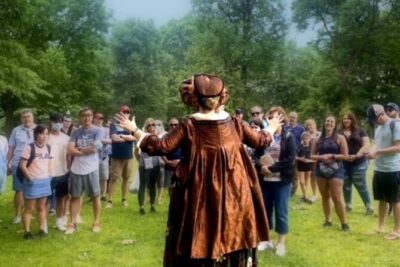 ★ 4.5Boston Freedom Trail Walking Tour with Costumed GuideFrom $262,531 reviews
 ★ 4.5Boston Tea Party Ships and Museum AdmissionFrom $352,512 reviews
 ★ 5.0The Full Revolutionary Story Epic Small Group Boston Walking TourFrom $552,356 reviews
 ★ 4.8Boston Tea Party Ships and Museum Interactive TourFrom $351,926 reviews
 ★ 5.0Boston Food & History: Pizza, North End & Freedom TrailFrom $901,772 reviews
 ★ 4.9Boston’s Freedom Trail: A Revolutionary Walking TourFrom $311,748 reviews
★ 4.9Freedom Trail History Small Group Walking TourFrom $351,590 reviews
★ 4.9Boston’s Freedom Trail: A Revolutionary Walking TourFrom $311,748 reviews
★ 4.9Freedom Trail History Small Group Walking TourFrom $351,590 reviews
Browse the lists this tour appears in