
REVIEW · HISTORICAL TOURS
2 Hour Boston Historical and Heritage Walking Tour
Two hours, nonstop Boston stories. For $5, this guided walk strings together big moments and street-level details, from Boston Common to Faneuil Hall. I really liked Stephen’s Q&A-friendly approach, and the easy photo stops that keep you close to the action.
The only catch is pacing: Stephen can move fast and talk a lot, so if you want slower breaks or lots of photo time, plan to linger on your own after the tour or arrive ready for Boston noise.
In This Review
- Key things I’d circle before you go
- Boston Common start: Freedom Trail energy on day one
- Park Street Church: abolition, missionary work, and a famous tune
- The 54th Regiment Memorial: history you can point at
- Massachusetts State House: the golden dome and the human stories on display
- Brahmins and books: the Private Library story as a thinking-person detour
- West End and Scollay Square: theaters, vaudeville, and the Kennedy Love Nest peek
- Old State House: Declaration readings and a Chicago rescue story
- Boston Massacre site and the Tea Party route: anger with a map
- Boston Irish Famine Memorial: immigration made visible in stone
- Old Corner Bookstore and Boston Latin School: literature and the start of public education
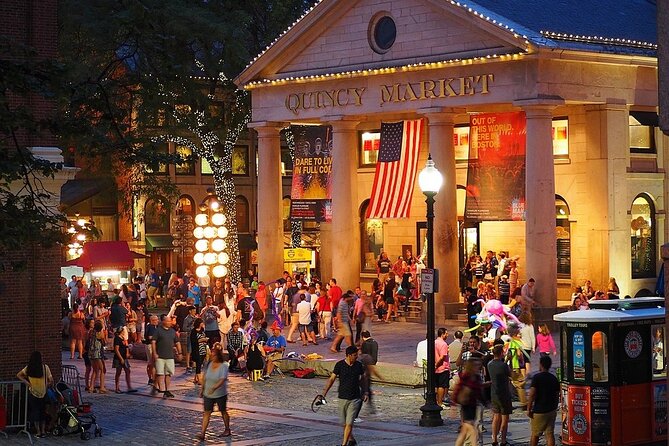
- Faneuil Hall Marketplace: Cradle of Liberty and the artillery company connection
- City Hall finale: Curley statues and an easy next step into the North End
- How the walk really feels: noise, pace, and where to stand
- Value check: what $5 buys you in Boston
- Should you book this Boston Historical and Heritage walk?
- FAQ
- How long is the Boston Historical and Heritage Walking Tour?
- How much does the tour cost?
- Where does the tour start and end?
- What language is the tour offered in?
- Are there admission fees for the stops?
- Is there a maximum group size?
- What ticket do you receive for the tour?
- Is the tour dependent on weather?
- Can you cancel for a full refund?
Key things I’d circle before you go
- Small-group energy (up to 24 people): easier questions, less wandering, and you’re not stuck behind ten strangers.
- Landmarks plus real context: you get why places mattered, not just what they look like.
- Abolition and Civil War reminders you’ll remember: Park Street Church and the 54th Regiment Memorial both land hard.
- Boston Common through multiple eras: from drills and duels to civil rights rallies, the park is the thread.
- Stops tied to words and ideas: the Old Corner Bookstore, Boston Latin School, and the Private Library of the Brahmins.
- Perfect “first Boston” orientation: the route gives you a clean map for what to explore next.
Boston Common start: Freedom Trail energy on day one
You begin at Boston Common, at the tablet by 1634 Freedom Trail (right where you can orient yourself fast). The guide kicks things off with why this park matters: it’s the oldest public park in America, and it’s been a meeting place in wildly different centuries.
You’ll hear about colonial military drills, cattle grazing across its forty-five acres, public violence like hangings and duels, and later civil rights rallies. It’s the kind of history that makes the ground under your feet feel busy, not dusty.
This first stop is also practical. Boston Common is wide, open, and photo-friendly, so it’s the right place to settle in before the tighter streets start. It’s free to visit, and the tour time here is short enough that you’re not stuck standing around too long.
Park Street Church: abolition, missionary work, and a famous tune
Next comes Park Street Church, tied to abolitionist organizing and intense missionary activity. Even if you’ve heard of abolition in Boston, the way this stop is framed helps you connect people, not just events.
One highlight is the debut of My Country, Tis of Thee (also known as America) by Samuel Francis Smith on July 4, 1831. That detail is useful because it shows how faith, public speaking, and national identity blended in the streets, not only in records.
This stop is brief, so don’t expect a long sit-down. Instead, treat it like a quick, high-impact stop that sets the moral mood for the rest of the walk.
Boston was built for walking. More routes

The 54th Regiment Memorial: history you can point at
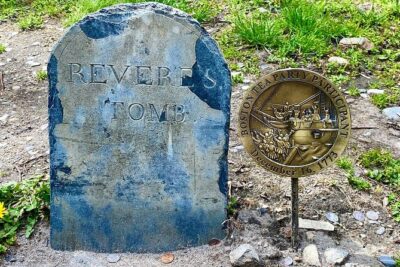
At the Robert Gould Shaw and the 54th Regiment Memorial, the tour shifts from speeches and songs to action and sacrifice. The story centers on the 54th Massachusetts Infantry Regiment—one of the first African American units in the Civil War—and their commander, Robert Gould Shaw.
The monument is a reminder that courage wasn’t theoretical here. It’s grounded in a specific unit and a specific leader, and you’ll get the meaning behind why the memorial exists in this exact place.
This is also a stop where you may want to slow your pace for photos and a moment of reflection. It’s free, it doesn’t require tickets, and it’s one of those locations that makes the entire walk feel more real.
Massachusetts State House: the golden dome and the human stories on display
Then you move to the Massachusetts State House, with that iconic golden dome that makes it hard to get lost. You’ll learn it’s been the seat of the state legislature since 1798, so it’s been shaping decisions for generations.
The tour points out statues with real moral weight, including General Joseph Hooker (with the legend attached to him) and Mary Dyer, who was hanged for her Quaker beliefs. This is one of the clearer examples on the route of how Boston’s religious and political history collide.
The time here is short, so your goal is quick pattern-spotting: notice the building, notice the symbols, and let the guide connect them to wider themes you’re seeing everywhere else.
Brahmins and books: the Private Library story as a thinking-person detour
One stop turns more intellectual. You’ll hear stories of the Private Library of the Brahmins, described as holding rare and valuable books, and you’ll get the idea of Boston’s elite shaping American thought.
Even though the tour doesn’t linger like a museum visit, this moment helps explain something big about the city. Boston wasn’t only politics and protests. It was also publishing, debate, and the power of who got heard.
If you like ideas, names, and how culture spreads, this is the kind of stop that gives you follow-up reading for the rest of your trip. Just keep in mind it’s delivered as a story stop, not a long room-time stop.
West End and Scollay Square: theaters, vaudeville, and the Kennedy Love Nest peek
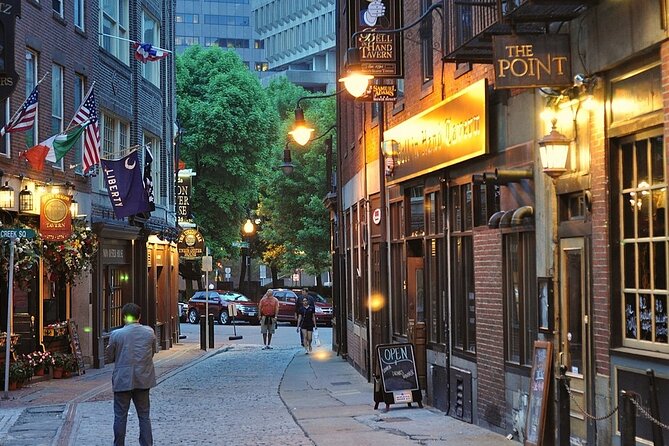
From there, the walk heads into the West End area and Scollay Square’s former entertainment district life. You’ll hear about theaters, vaudeville shows, and colorful characters—so the city feels less solemn and more like a lived-in place.
Along the way, the tour includes a peek at the Love Nest of the Kennedys. It’s a quick look, but it’s the kind of detail that makes your Boston photos feel more specific than just famous-sounding addresses.
This portion is also where you should expect more street noise and movement. If you’re the type who likes to pause and frame every shot, give yourself extra patience here. The guide’s job is timing, and the city doesn’t slow down for anyone.
Three centuries deep, more Boston history
- Boston: Freedom Trail History Small Group Walking Tour★ 5.0 · 6,450 reviews
- Boston Food & History: Pizza, North End & Freedom Trail★ 5.0 · 1,772 reviews
- Boston: Freedom Trail History Small Group Walking Tour★ 4.9 · 1,590 reviews
- City Cruises Boston Historic Sightseeing Harbor Cruise★ 4.5 · 1,388 reviews
- Boston’s North End Food Tour: Italian Flavors & Heritage Walk★ 5.0 · 1,322 reviews
Old State House: Declaration readings and a Chicago rescue story
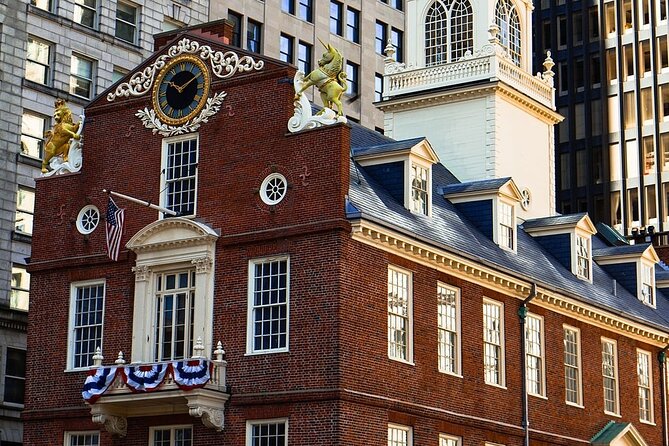
You’ll then stand in the shadow of the Old State House, which keeps showing up like a character in Boston’s revolutionary plot. The tour tells you about key events there, including the reading of a copy of the Declaration of Independence to Boston citizens in 1776.
One of the more memorable threads is the fate of the building. When it fell into disrepair at the end of the nineteenth century, the city of Chicago offered to buy it, and Bostonians stepped in to salvage and meticulously restore the site.
That story does two things. It adds drama, and it explains why you’re looking at the building today instead of a blank lot or a relocated artifact.
Boston Massacre site and the Tea Party route: anger with a map
Next is the Boston Massacre site, the lead-up spark that turned tension into outrage. You’ll hear the gripping confrontation between British soldiers and American colonists and how that moment fueled broader revolutionary momentum.
After that, the walk moves to the Tea Party story with a very specific time and place. You’ll learn that on December 16, 1773, five thousand citizens gathered in a plain, Puritan-style setting to agree to prevent the landing of British tea ships.
Then comes the key action: men disguised as Mohawk Indians led a mob down Milk Street toward Griffiths Wharf for the Tea Party, which the guide explains as a spark for rebellion.
This is the tour’s best “how things really moved” stretch. You’re not only learning what happened—you’re tracing how people traveled, gathered, and acted.
Boston Irish Famine Memorial: immigration made visible in stone
A quieter, heavier stop follows at the Boston Irish Famine Memorial. It’s a tribute to thousands of Irish immigrants who fled the Great Famine of 1845 to 1852 and found refuge in Boston, becoming the largest ethnic group by 1850.
The memorial also widens the lens to honor immigrant groups in general. That matters because the tour otherwise leans strongly toward revolution and the formation of the nation. Here, you see what it cost to survive and rebuild.
This stop is short, but it lands. If you like meaningful pauses during a walking tour, this is one of them.
Old Corner Bookstore and Boston Latin School: literature and the start of public education
Two stops connect the city to schooling and writing in a way that feels oddly personal while you’re walking.
First, the Old Corner Bookstore. You’ll hear its timeline: built as a residence and apothecary in 1718, first used as a bookstore in 1828, and for three decades home to Ticknor and Fields publishers. It was a meeting place for Henry Wadsworth Longfellow, Nathaniel Hawthorne, Oliver Wendell Holmes Sr., and Ralph Waldo Emerson.
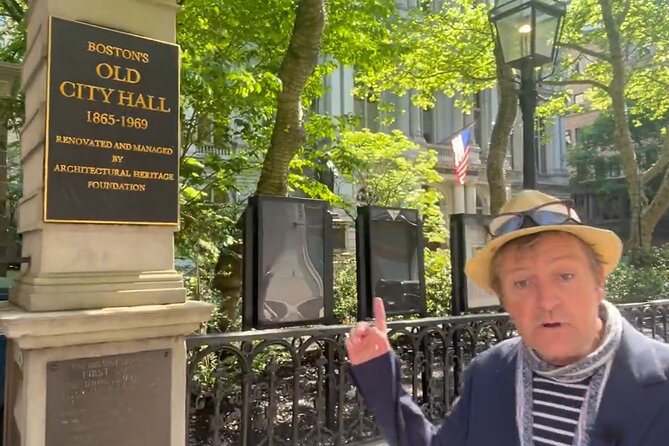
Then comes Boston Latin School. School Street is named for the site of the first public school in the United States, and the tour also passes by King’s Chapel, Old City Hall, and the Parker House. You’ll even meet Boston’s donkey waiting patiently on School Street, a fun little reset after the heavier stops.
This pairing works well because it shows two kinds of power. Books helped ideas travel. Schools helped ideas reproduce.
Faneuil Hall Marketplace: Cradle of Liberty and the artillery company connection
At Faneuil Hall Marketplace, the tour leans into democracy talk, but with enough detail to keep it grounded. You’ll hear that it’s sometimes called the Cradle of Liberty and that the building was gifted to Boston by Peter Faneuil, who was also a slave trader.
The guide points out the grasshopper weathervane and shares the backstory that it’s believed to be modeled after London’s Royal Exchange. It’s one of those fun facts that makes your photo feel like more than a snap.
You’ll also learn Faneuil Hall is the headquarters of the Ancient and Honorable Artillery Company of Massachusetts, described as the oldest military body in the Western Hemisphere with a charter from 1837. This is a reminder that civic life in Boston mixed ideals with institutions.
City Hall finale: Curley statues and an easy next step into the North End
The tour ends near Boston City Hall, in the shadow of two statues of James Michael Curley, a four-time mayor, governor of Massachusetts, and congressman. The tour frames him as a long-running political figure with a flamboyant reputation.
From there, you’re positioned near the cluster of classic stops like Union Oyster House and the Bell in Hand tavern, described as the oldest pub in town. Hanover Street is also nearby, the gateway to the historic North End.
Time-wise, this end stretch is a good landing pad. You’ve built context for the city, and now you’re in the zone where food and wandering make sense.
How the walk really feels: noise, pace, and where to stand
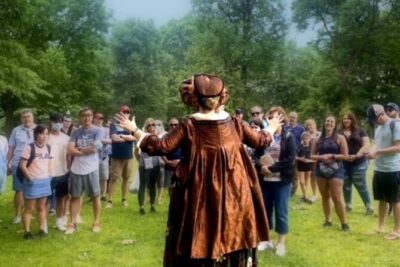
This tour is built on walking plus nonstop storytelling. The guide uses a mobile ticket and leads a group capped at 24 people, which helps you move together without getting swallowed by a crowd.
In practice, the pace can feel fast. Stephen is described as energetic and story-forward, and a few people noted it can be a lot of information at once. If you want slower timing, aim to stay close so you can catch every detail without turning your head the whole time.
Boston can be loud too, especially with other loud tour groups nearby. One practical fix mentioned is the use of a voice amplifier microphone, which is a good sign if you struggle to hear in street-level noise.
Value check: what $5 buys you in Boston
At $5, you’re paying for a guide-led route and context across major landmarks. Every listed stop here is free to enter, so your costs stay simple: transportation, snacks, and whatever you decide to do after.
The “value” isn’t just price. It’s the way the tour connects themes. You’ll see how public spaces like Boston Common become stages for politics. You’ll connect music and abolition. You’ll connect revolutionary action to specific streets.
So if you’re trying to get your bearings fast while still learning real details, this is a smart buy. And because the route is built for a two-hour window, it works as a morning anchor on your first day—or as an afternoon reset if you want a clean story line.
Should you book this Boston Historical and Heritage walk?
Book it if you want a fast, meaningful orientation through the core of Boston Common to Faneuil Hall, with stops that cover abolition, the Civil War, revolution, and immigration. This is especially good for people who like asking questions and getting real names and dates attached to the places they’re seeing.
Skip it if you need long photo pauses, very slow walking, or a museum-style pace. The guide can be talk-heavy and the route depends on weather and street conditions, so you’ll get the best experience by dressing for wind/cold and staying near the front when sound gets tricky.
If you’re the kind of visitor who likes learning the story behind what you’re photographing, this tour is an easy yes.
FAQ
How long is the Boston Historical and Heritage Walking Tour?
The tour lasts about 2 hours.
How much does the tour cost?
It costs $5.00 per person.
Where does the tour start and end?
It starts at Boston Common at the Boston Common Tablet (1634 Freedom Trl). It ends by the James Michael Curley Statues at Congress St @ North St, and the route finishes directly across from Faneuil Hall.
What language is the tour offered in?
The tour is offered in English.
Are there admission fees for the stops?
The listed stops show free admission, and the tour highlights free-entry locations.
Is there a maximum group size?
Yes. The tour has a maximum of 24 travelers.
What ticket do you receive for the tour?
You receive a mobile ticket.
Is the tour dependent on weather?
Yes. The experience requires good weather, and if canceled due to poor weather you’ll be offered another date or a full refund.
Can you cancel for a full refund?
Yes. Free cancellation is allowed, and you can cancel up to 24 hours in advance for a full refund.
Boston History, Volume Two



On Foot Through Old Boston

More of the Boston Ledger


New on the Boston Docket
- Boston to Newport Mansions Private Day Trip
★ 5.0 · 3 reviews - Boston Massachusetts Private Photography Tour
★ 5.0 · 3 reviews - Homemade Dumplings 101 in Boston
★ 3.5 · 3 reviews - Self-Guided Audio Tour of Boston North End
★ 4.5 · 3 reviews - Old Boston: Beacon Hill & Back Bay Walking Tour in French
★ 4.7 · 3 reviews
Historical Tours, compared.
 ★ 5.0History and Hauntings of Salem Guided Walking TourFrom $3614,564 reviews
 ★ 5.0Freedom Trail History Small Group Walking TourFrom $356,450 reviews
 ★ 4.5Tour of Historic Fenway Park, America’s Most Beloved BallparkFrom $453,013 reviews
 ★ 5.0Boston Food & History: Pizza, North End & Freedom TrailFrom $901,772 reviews
 ★ 4.6City Cruises Historical Sightseeing CruiseFrom $461,771 reviews
★ 4.9Freedom Trail History Small Group Walking TourFrom $351,590 reviews
★ 4.6City Cruises Historical Sightseeing CruiseFrom $461,771 reviews
★ 4.9Freedom Trail History Small Group Walking TourFrom $351,590 reviews
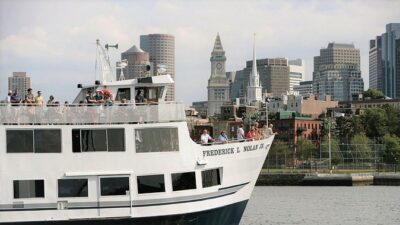 ★ 4.5City Cruises Boston Historic Sightseeing Harbor CruiseFrom $461,388 reviews
 ★ 5.0Boston’s North End Food Tour: Italian Flavors & Heritage WalkFrom $701,322 reviews
Browse the lists this tour appears in