
REVIEW · NEW ENGLAND DAY TRIPS FROM BOSTON
Boston Record Breakers: Self-Guided Scavenger Hunt
Boston turns into a game map. This self-guided scavenger hunt lets you learn the city by solving clues offline and moving from landmark to landmark. You also get your own pace, which is a big deal in a walking city like Boston.
I like that it feels private and low-pressure. It’s set up as a no-contact, private activity, so you’re not stuck matching someone else’s speed, and you can pause and resume later.
One possible drawback: a couple clue steps can feel a bit tricky, so if you enjoy totally brainy puzzles with no hints, you might want to be ready to slow down and read carefully—especially around transit and the finale near Union Oyster House.
In This Review
- Key things I’d flag before you play
- Why a self-guided scavenger hunt beats a standard Boston tour
- Price and time: $5.99 for a focused 1 hour 20-minute walk
- Route game plan: from Boston Public Library to Union Oyster House
- Stop-by-stop: what you’ll notice along this Boston path
- Boston Public Library (Central Library): a public institution that changed how cities think
- Copley Square: culture, name changes, and the art square backstory
- Arlington Street Church: architecture that nods to London
- Ether Monument (The Good Samaritan): a fountain tied to anesthesia history
- Massachusetts State House: Charles Bulfinch and the seat of government
- Robert Gould Shaw Memorial (54th Regiment): one of Boston’s most important civil war markers
- Park Street: street names that link politics, publishing, and women’s journalism
- Tremont Temple: a church building shaped by fire history and replacement
- Alexander Graham Bell: phone inventor, local teaching, and a 1916 BU moment
- The Tavern (1795): a named meeting point for printers, politicians, sailors, and students
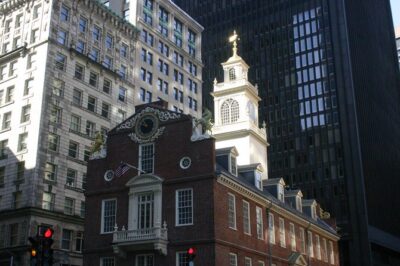
- Union Oyster House: the Freedom Trail finale and America’s oldest restaurant
- How to play well: practical tips for finding answers faster
- Is this scavenger hunt worth it for your trip style?
- Should you book Boston Record Breakers?
- FAQ
- Do I need an internet connection to play this Boston scavenger hunt?
- How long does the Boston Record Breakers scavenger hunt take?
- Where does the scavenger hunt start and end?
- Is this a guided tour with a person?
- What language is the experience in?
- Can I cancel and get a refund?
Key things I’d flag before you play
- Offline mode: You can play without internet, so you’re not stuck hunting for signal.
- Flexible start time: Start anytime during the day and resume later if you need a break.
- Private/no human contact: It’s you and the app, not a group tour crowd.
- Historic landmarks in order: The route hits major sites from the Boston Public Library all the way to the Freedom Trail area.
- Great value for time: About 1 hour 20 minutes, priced at $5.99 per person.
- Watch for clue ambiguity: A few spots may require extra attention or hints.
Why a self-guided scavenger hunt beats a standard Boston tour
Boston can feel like a blur when you’re on a typical group schedule. This format flips that. Instead of hearing a lecture at each stop, you follow clues that push you to notice details on your own.
The biggest win here is offline play. That means you can keep moving even if your phone struggles with signal or your battery gets nervous. You’ll be looking around anyway—so the app being offline matches the whole street-level vibe of the game.
I also like the solo-control feeling. The hunt is designed so you can start at any time, pause whenever you want, and continue later. If you decide the weather needs respect or you just want a quick coffee stop, you can do that without feeling like you’re falling behind a guide.
Price and time: $5.99 for a focused 1 hour 20-minute walk
At $5.99 per person for roughly 1 hour 20 minutes, you’re buying structure, not a storyteller. And that’s where the value comes from. You get a built-in route, prompts that make you look twice, and a finish at a classic stop where you can reward yourself.
Think of it like “guided discovery” with a light footprint. You’re not paying for transportation, and you’re not paying for a human guide’s time. The result is ideal for travelers who like independent exploring but still want an easy game plan.
Do note the time estimate is “about.” Your pace matters, and the clues ask you to scan the real environment. If you like solving puzzles slowly (or you need a couple extra reads), you might stretch the session a bit.
More clues hidden between the cobblestones

Route game plan: from Boston Public Library to Union Oyster House
The route is simple: you start at the Boston Public Library – Central Library on Boylston Street, then work through a string of major Boston sights, and finish at Union Oyster House. The end point is smart because it’s a real-world place to eat or reset your energy.
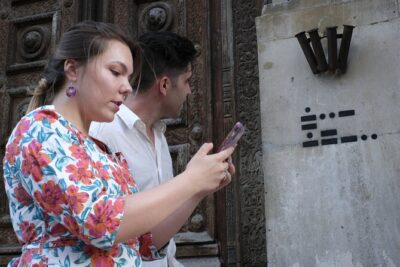
At each stop, you’ll be asked to look around and find the answer that moves you to the next location. That means you’re not just staring at plaques—you’re actively hunting for what the clue is pointing at.
The app approach also keeps things flexible. This is listed as “always available” and open 24/7, so you’re not stuck picking a specific tour departure time. You can also start at any hour, and you can take breaks and resume later.
Stop-by-stop: what you’ll notice along this Boston path
Below is what each landmark adds to the game. I’m focusing on what makes the stop worth your attention, plus the kind of “looking around” the clue likely wants you to do.
Boston Public Library (Central Library): a public institution that changed how cities think
The hunt starts at the Boston Public Library, established in 1848. It’s presented as a pioneer of public library service in America: first large free municipal library, first public library to lend books, first to have a branch library, and the first with a children’s room.
This is a great opener because it trains your brain fast. You’ll get used to scanning for details—inscriptions, design cues, and the kinds of historical labels that Boston buildings love to share.
If you’re the type who likes to understand why a place matters before you move on, you’ll appreciate this start. It sets a tone of “civic pride” that fits the rest of the route.
Copley Square: culture, name changes, and the art square backstory
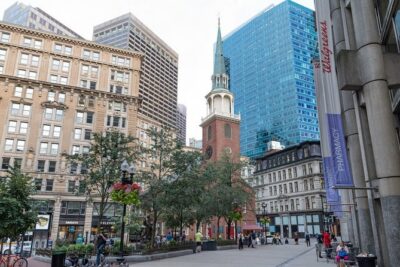
Next comes Copley Square, in Boston’s Back Bay. The square is named for painter John Singleton Copley, and before 1883 it was known as Art Square because of the many cultural institutions nearby.
For the game, this is the kind of location where clues push you to connect a name with a setting. If you look carefully, you’ll start seeing how Boston’s identities are layered—Art Square becomes Copley Square, and the institutions leave traces even when the labels evolve.
Boston is a fine base camp. More of New England from here
- Boston to Newport Small-Group Day Trip with Breakers & Marble House Admission★ 4.5 · 266 reviews
- Boston to New Hampshire Fall Foliage White Mountains Day Trip★ 5.0 · 251 reviews
- Boston to Kennebunkport Day Trip with Optional Trolley Tour★ 4.5 · 166 reviews
- Boston to Kennebunkport with Optional Lobster Tour★ 5.0 · 44 reviews
- Boston to Newport: Breakers and Marble House Small Group Tour★ 4.5 · 29 reviews
Arlington Street Church: architecture that nods to London
You’ll then come to the Arlington Street Church, a Unitarian Universalist church across from the Public Garden. It was completed in 1861, designed by Arthur Gilman and Gridley James Fox Bryant, and it’s noted for resembling St. Martin-in-the-Fields in London.
This stop is a clue-friendly choice. Churches like this often hide meaning in shape and style, so you’re not just reading—you’re comparing.
If you enjoy architecture, this is one of the more rewarding moments on the walk. Even if you don’t “study” buildings, you’ll probably notice the design references once the clue gets you looking.
Ether Monument (The Good Samaritan): a fountain tied to anesthesia history
Near the northwest corner of the Public Garden, you’ll hunt for the Ether Monument, also called The Good Samaritan. It commemorates the use of ether in anesthesia, and at 40 feet tall, it’s described as the oldest monument in the public garden.
This is a strong mid-route highlight because it’s unusual. You’re seeing Boston’s medical impact without it feeling like a museum stop.
When clues reference things like size, location, or what a monument commemorates, they’re usually asking you to observe the monument’s physical presence and context. It’s a “look up and locate” type of moment.
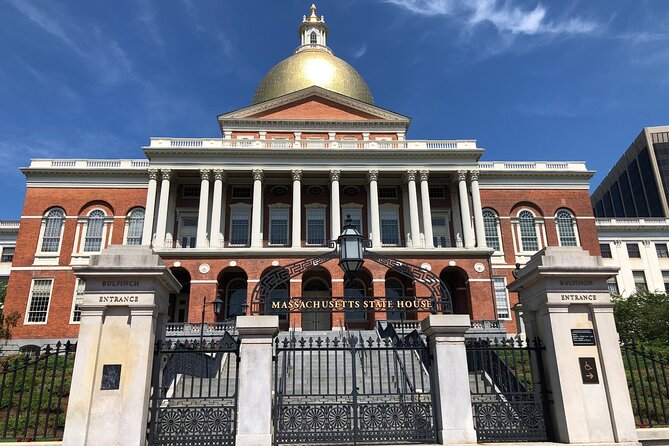
Massachusetts State House: Charles Bulfinch and the seat of government
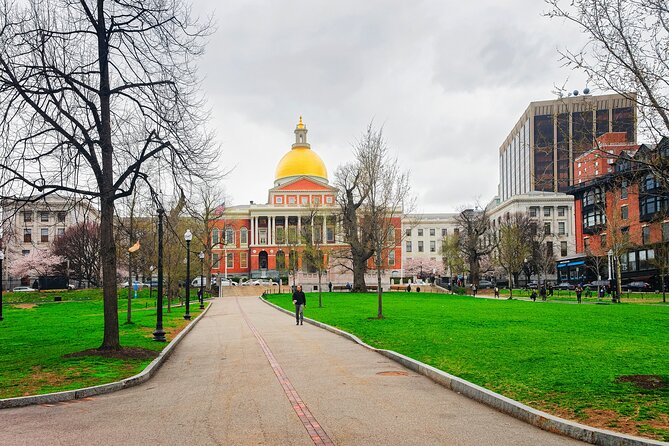
The game moves to the Massachusetts State House in Beacon Hill. Designed by Charles Bulfinch, it was completed in January 1798 and houses the Massachusetts General Court and the governor’s offices.
This part helps you make sense of Boston as a governing center, not just a sightseeing city. The State House is one of those landmarks where the exterior tells you a lot—and your clue likely steers you toward a detail that ties function and design together.
Robert Gould Shaw Memorial (54th Regiment): one of Boston’s most important civil war markers
Next is the memorial to Robert Gould Shaw and the Massachusetts Fifty-Fourth Regiment, a bronze relief sculpture by Augustus Saint-Gaudens. It depicts Shaw leading the 54th Regiment and is opposite 24 Beacon Street, at the edge of Boston Common. The sculpture was unveiled May 31, 1897 and is described as the first civic monument to honor the heroism of African American soldiers.
This stop gives the route emotional weight. Because it’s a relief sculpture, the “look around” part matters—your clue is likely pushing you to notice how the scene is arranged and what names or figures are highlighted.
If you want your scavenger hunt to include something meaningful (not just pretty architecture), this is where it happens.
Park Street: street names that link politics, publishing, and women’s journalism
You’ll then pass through Park Street, laid out in 1804 as Park Place, replacing Sentry Street. In the 1880s, the Woman’s Journal was published on Park Street, and Houghton Mifflin had its headquarters here in the late 19th century.
This stop is great for people who like “how cities evolve.” Boston’s street names are often a shorthand for bigger stories, and your clue likely wants you to connect a title or date to a location.
Also: Park Street is the kind of area where you may naturally drift into “busy-city mode,” so slow down. The clue is trying to make you look at the specific point, not just the general neighborhood vibe.
Tremont Temple: a church building shaped by fire history and replacement
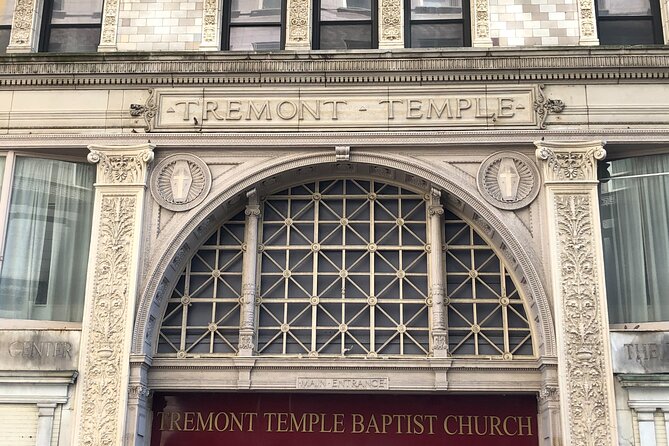
At 88 Tremont Street, you’ll find the Tremont Temple, a Baptist church. It opened in May 1896 and was designed by architect Clarence Blackall. The existing multi-storey structure replaced an earlier 1827 building that had repeatedly suffered damage by fires.
This is one of the more “story-in-the-stones” stops. Your clue will likely encourage you to look for evidence of that replacement history—dates, naming, or architectural cues tied to the later structure.
If you like how buildings carry old events forward, you’ll enjoy the feel of this stop.
Alexander Graham Bell: phone inventor, local teaching, and a 1916 BU moment
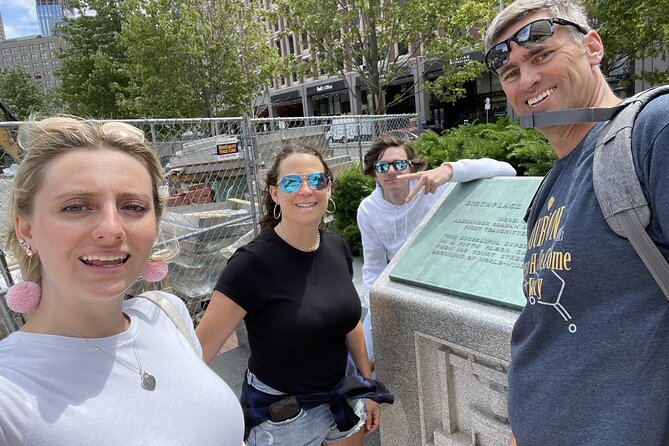
You’ll hunt near a spot connected to Alexander Graham Bell. He was a BU professor from 1874 to 1879 and invented the telephone in 1876, after research funded by BU. The info notes he appears here at a 1916 BU reception marking the 40th anniversary of the invention.
For the game, this is a classic clue setup: invention, local university ties, and a dated commemoration. It’s one of those places where you’re not just learning a fact—you’re connecting a person’s life timeline to a physical marker.
This stop works well if you like “Boston did this too” moments.
The Tavern (1795): a named meeting point for printers, politicians, sailors, and students
Finally, you’ll come to The Tavern, which has been around since 1795. It was described as a gathering place for printers and politicians, sailors and students, and it quickly became Boston’s most famous alehouse.
This is a great “reset” stop. You’re walking, solving, and then—suddenly—Boston history feels like a living social space.
Even if you don’t grab a drink, this is one of the places where you can let the city’s past feel human.
Union Oyster House: the Freedom Trail finale and America’s oldest restaurant
The end point is Union Oyster House, located near Faneuil Hall on the Freedom Trail. It’s described as America’s oldest restaurant, serving food since 1826, housed in a building dating back to pre-Revolutionary days.
The story includes that Daniel Webster was a constant customer, and that the stalls and oyster bar have been kept in their original positions. The game ends here because it’s a natural payoff: a real meal in a spot that’s historically loaded.
One practical note: the finale is fun, but it may also be one of the spots where a clue step can feel harder to pin down quickly. If you like your scavenger hunts to feel crystal-clear, give yourself a little extra patience at the finish.
How to play well: practical tips for finding answers faster
Because the hunt depends on looking around, phone handling matters. I’d keep your battery topped up and your brightness reasonable so you can read the clue prompt without squinting.
Also, don’t rush from clue to clue. In the real world, Boston streets are crowded with competing details—signs, materials, plaques, and angles. If a clue feels vague, slow down and re-check the exact wording.
Here’s the play strategy that usually saves time:
- Read the clue, then identify the type of thing it wants (name? date? monument? building feature?).
- Look for the location clue first (near an intersection, across from a park, edge of a green space).
- Only then hunt for the specific answer detail.
Finally, if you hit a snag, treat it like a puzzle, not a failure. Some parts of the route are easier than others, and the provided rating history (4.3 across 4 ratings) shows a couple of people felt certain clues needed more guidance. That’s your signal to stay flexible, not to assume you’re doing something wrong.
Is this scavenger hunt worth it for your trip style?
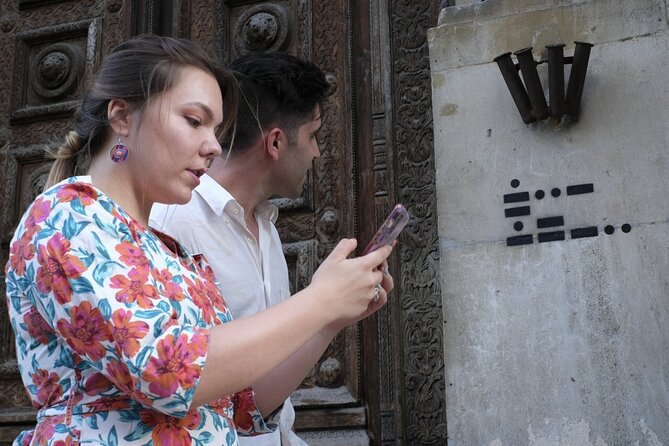
This works especially well if you fit any of these:
- You like walking and want a loose plan without a strict group schedule.
- You want a low-cost way to get historical exposure across multiple major landmarks.
- You prefer self-paced exploring and the freedom to pause without asking permission.
- You’re traveling with your own group and want a private experience without matching another tour’s timing.
It’s also a good pick for people who hate the “stand in a circle while someone explains it all” model. Here, you do the seeing, then you do the solving.
On the other hand, if you’re hunting for highly polished, ultra-clever puzzles with no ambiguity, you might find the clue experience a bit uneven. The overall feedback suggests this isn’t a flawless puzzle factory.
Should you book Boston Record Breakers?
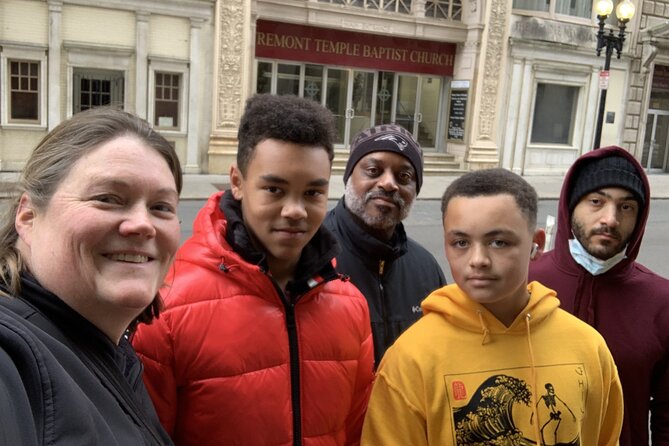
If you want a budget-friendly, offline-friendly way to get a highlight tour feel—without the crowds or fixed departure times—this is a strong choice. The route covers major Boston anchors (library, squares, church and park landmarks, government buildings, civil war memorial, and a Freedom Trail finale), and the ending at Union Oyster House is a satisfying place to land.
I’d book it if you like independence and you don’t mind a couple moments where you have to read closely and look around longer than expected. With that mindset, you’ll likely finish the hunt feeling like you actually learned the city instead of just passing through it.
FAQ
Do I need an internet connection to play this Boston scavenger hunt?
No. The game is designed so you can play offline, and you do not need an internet connection to play the city game.
How long does the Boston Record Breakers scavenger hunt take?
It’s listed at about 1 hour 20 minutes.
Where does the scavenger hunt start and end?
It starts at the Boston Public Library – Central Library, 700 Boylston St, Boston, MA 02116 and ends at Union Oyster House, 41 Union St, Boston, MA 02108.
Is this a guided tour with a person?
No. It’s a self-guided experience with no physical tour guide. You use the Questo mobile app.
What language is the experience in?
The experience is offered in English.
Can I cancel and get a refund?
Yes. The experience offers free cancellation, with a full refund if you cancel at least 24 hours before the start time.
More of the Boston Ledger




New England, Day by Day




Boston, Solved Clue by Clue




New on the Boston Docket
- Boston to Newport Mansions Private Day Trip
★ 5.0 · 3 reviews - Boston Massachusetts Private Photography Tour
★ 5.0 · 3 reviews - Homemade Dumplings 101 in Boston
★ 3.5 · 3 reviews - Self-Guided Audio Tour of Boston North End
★ 4.5 · 3 reviews - Old Boston: Beacon Hill & Back Bay Walking Tour in French
★ 4.7 · 3 reviews
New England Day Trips from Boston, compared.
 ★ 4.5Boston to Newport Small-Group Day Trip with Breakers & Marble House AdmissionFrom $155266 reviews
 ★ 5.0Boston to New Hampshire Fall Foliage White Mountains Day TripFrom $150251 reviews
 ★ 4.5Boston to Kennebunkport Day Trip with Optional Trolley TourFrom $135166 reviews
 ★ 5.0Boston to Kennebunkport with Optional Lobster TourFrom $12544 reviews
 ★ 4.5Boston to Newport: Breakers and Marble House Small Group TourFrom $16929 reviews
 ★ 5.0Private Day Trip to Salem and Hammond Castle from BostonFrom $49515 reviews
 ★ 5.0Salem and North Shore Full Day Private TourFrom $99513 reviews
 ★ 5.0Kennebunkport Day Trip with Optional Lobster TourFrom $12511 reviews
Browse the lists this tour appears in